
Running your own business, taking contract work or earning commissions can make a bank nervous, even when your income is solid. Without regular pay stubs, an automated approval system may simply say no. Specialist lenders read your file differently, looking at deposits and tax records instead. Car Loan Finder is not a lender: we match your application in La Have with lenders that understand self-employed income, using a soft inquiry that does not affect your credit score.
Buying a vehicle from La Have means working with Nova Scotia's rules. Every purchase carries the 14% HST, which adds $3,500 to a $25,000 vehicle, and insurance is sold by private insurers, so it pays to compare quotes. Because your approval is not tied to one dealer, you can shop around the province, Halifax included, and pick the vehicle that fits. Car sales are covered by provincial consumer protection law if anything goes wrong.
Facts reviewed October 29, 2026 · See sources
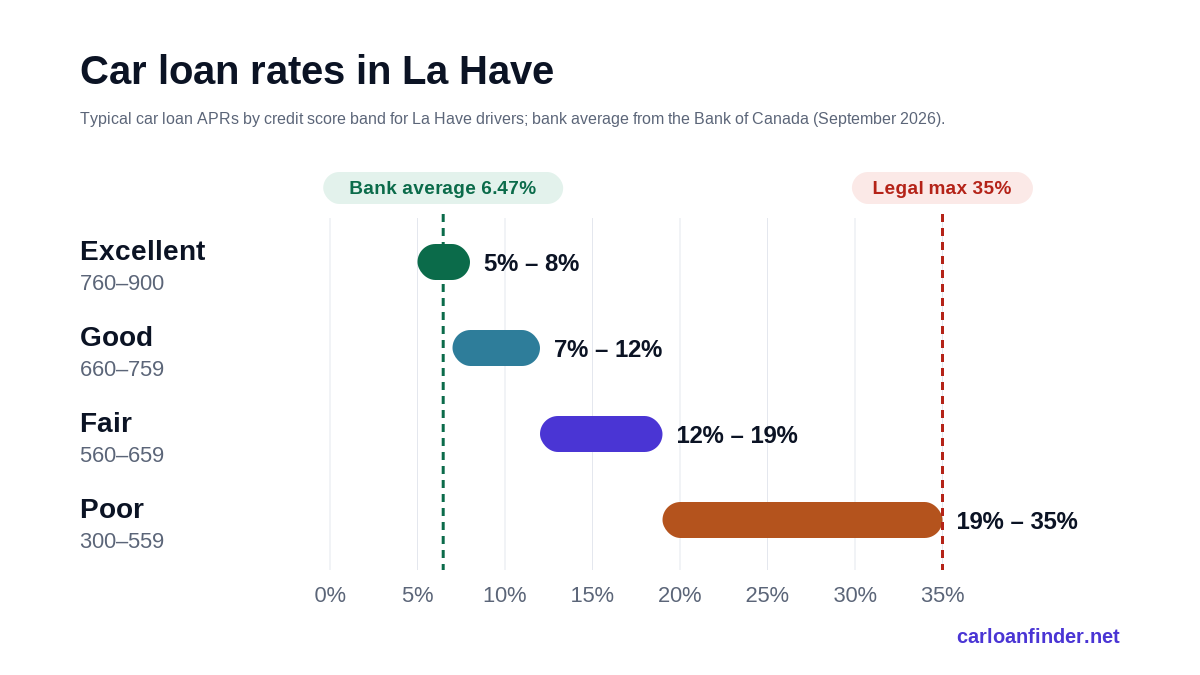
What interest rate can you get in La Have?
Most bank car loans are priced above prime. Dealer-arranged and specialist lenders set their own fixed rates, which is why credit score matters more than the Bank of Canada rate for bad credit borrowers.
| Credit tier | Equifax score | Typical APR | Example payment* |
|---|---|---|---|
| Excellent | 760–900 | 5% – 8% | $420/mo |
| Good | 660–759 | 7% – 12% | $457/mo |
| Fair | 560–659 | 12% – 19% | $535/mo |
| Poor | 300–559 | 19% – 35% | $704/mo |
| Legal maximum | — | 35% APR | Criminal Code, s. 347 |
* Score bands from Equifax Canada. Rate ranges are estimates published by Loans Canada, not quotes; your rate depends on income, debts, down payment, term and the vehicle. Example payment: $25,000 over 72 months at the middle of each range.
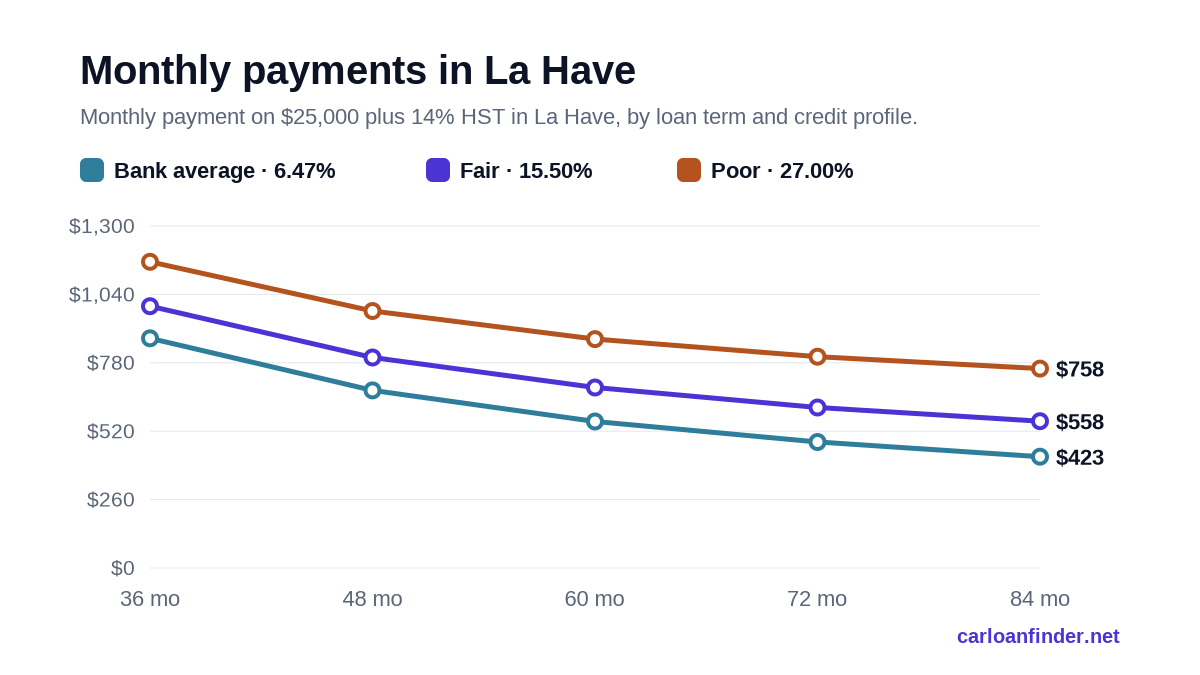
Monthly payments on a La Have car loan
| Credit profile | 48 months | 60 months | 72 months | 84 months | Interest (72 mo) |
|---|---|---|---|---|---|
| Bank average 6.47% APR | $593 | $489 | $420 | $371 | $5,232 |
| Good 9.50% APR | $628 | $525 | $457 | $409 | $7,894 |
| Fair 15.50% APR | $702 | $601 | $535 | $489 | $13,551 |
| Poor 27.00% APR | $857 | $763 | $704 | $665 | $25,719 |
Monthly payment on $25,000 before tax, using the Bank of Canada average for bank borrowers and the middle of each published credit-tier range. In Nova Scotia, 14% HST adds about $3,500 if it is financed.
Which La Have lender fits your credit?
Where you borrow matters as much as your credit score. Banks and credit unions usually offer the lowest rates but expect good credit; specialist lenders approve more credit profiles at higher rates. Here is how the options compare.
| Lender | Best for | How rates are set | Watch out for |
|---|---|---|---|
| Bank | Good to excellent credit | Usually priced above prime; close to the 6.47% bank average | Stricter approval; may require a larger down payment with lower scores |
| Credit union | Members with fair to good credit | Set by each credit union; often competitive with banks | Membership required; rules vary by province |
| Manufacturer finance | New vehicles, good credit | Promotional rates set by the automaker | A low rate may replace a cash rebate — compare both |
| Specialist (subprime) lender | Bad credit, proposals, newcomers | Higher fixed rates, up to the 35% legal maximum | Read the total cost of borrowing before you sign |
| Buy here, pay here dealer | When other lenders decline | Often the highest rates allowed | Limited vehicle choice; payments may not be reported to credit bureaus |
| Car Loan Finder | Every credit profile | Matched to lenders for your credit situation | One application; no impact on your credit score to see options |
Your La Have car loan, step by step
- 1 Check your credit report You can get your credit report free from both Equifax and TransUnion. Dispute any errors before a lender sees them.
- 2 Set your budget Use the payment table above to find a payment that leaves room for insurance, fuel and maintenance.
- 3 Get pre-approved A pre-approval shows your likely rate and limit before you choose a car. Checking your options with Car Loan Finder is a soft inquiry.
- 4 Compare the total cost of borrowing Lenders must disclose the APR and total cost of borrowing in writing. Compare that figure, not only the monthly payment.
- 5 Keep the term as short as you can afford Longer terms lower the payment but cost more interest and raise the risk of owing more than the car is worth.
Your credit situation, explained
Bankruptcy or consumer proposal
A first bankruptcy usually stays on your Equifax report for 6 years after discharge; a consumer proposal stays until 3 years after you complete it. Specialist lenders can approve you before those dates — often with a down payment.
No credit history
If you are new to Canada or have never borrowed, lenders look at income, employment and residency instead of a score. A larger down payment or a co-signer improves your options.
Self-employed
Expect to show recent bank statements and your Notices of Assessment from the Canada Revenue Agency instead of pay stubs.
Rebuilding after missed payments
On-time car payments are reported to the credit bureaus by most lenders. Choosing a payment you can always make is the fastest way to rebuild.
Documents that stand in for pay stubs
Lenders that work with self-employed applicants usually ask for recent bank statements and your Notices of Assessment from the Canada Revenue Agency. Together they show what you earn after business expenses, which is the figure used to set your payment. Gather them before you start.
If your income is seasonal or uneven, a longer run of statements helps a lender see the full year rather than a slow month. Keep business and personal accounts separate where you can; it makes your deposits much easier to read.
When write-offs shrink your reported income
Claiming every possible expense lowers your tax bill, but it also lowers the income a lender sees on your Notice of Assessment. That can limit how much you are approved for, even if your business is doing well. It is worth a conversation with your accountant before you apply.
A down payment is one way around this. It reduces the amount you need to borrow, so a smaller approved income still covers the payment. A co-signer with steady employment is another option, though they share responsibility for the loan.
Matching the term to your cash flow
Published estimates by Equifax score band put good credit at 7–12%. At 9.50%, $25,000 works out to about $457 a month over 72 months. At the 6.59% bank average, the same loan is about $421 over 72 months or $594 over 48.
A longer term can give breathing room in leaner months, but it adds interest: at the bank average, 84 months instead of 60 adds about $1,863. If your contract allows prepayment without a fee, extra payments in strong months can shorten the loan.
Local costs and protections in Nova Scotia
- Auto insurance in Nova Scotia is sold by private insurers, so compare several quotes. Lenders need proof of full coverage before you take delivery.
- Car sales in Nova Scotia are covered by provincial consumer protection law. Contact the provincial consumer protection office if a dealer misleads you.