Start with the tax: why HST changes the math
Nova Scotia charges 14% HST on vehicle purchases, which comes to about $3,500 on a $25,000 car. Many buyers roll that tax into the loan without noticing, which means paying interest on the tax for the whole term. At a subprime rate, that adds a noticeable amount to the total cost of the vehicle.
Covering the tax with a down payment or a trade-in is one of the simplest ways to make a bad credit loan cheaper. It reduces the amount financed, lowers the lender's risk and can move you into a shorter term. Even if you cannot cover all of it, every dollar you put down is a dollar you do not pay interest on.
When you receive quotes, check that each one shows the price before tax, the tax itself and the amount financed on separate lines. Quotes that only show a payment make comparison impossible and are the first thing to push back on. A reputable dealer will provide a full breakdown on request, and you can take it home to review before deciding.
Putting offers side by side
For each offer, write down five figures: the amount financed, the annual rate, the term in months, the monthly payment and the total cost of borrowing. Add any required down payment and every fee. With those in a simple table, the cheaper offer is usually obvious, even when its payment is higher. Ask each lender for the figures in writing so nothing changes between the quote and the contract.
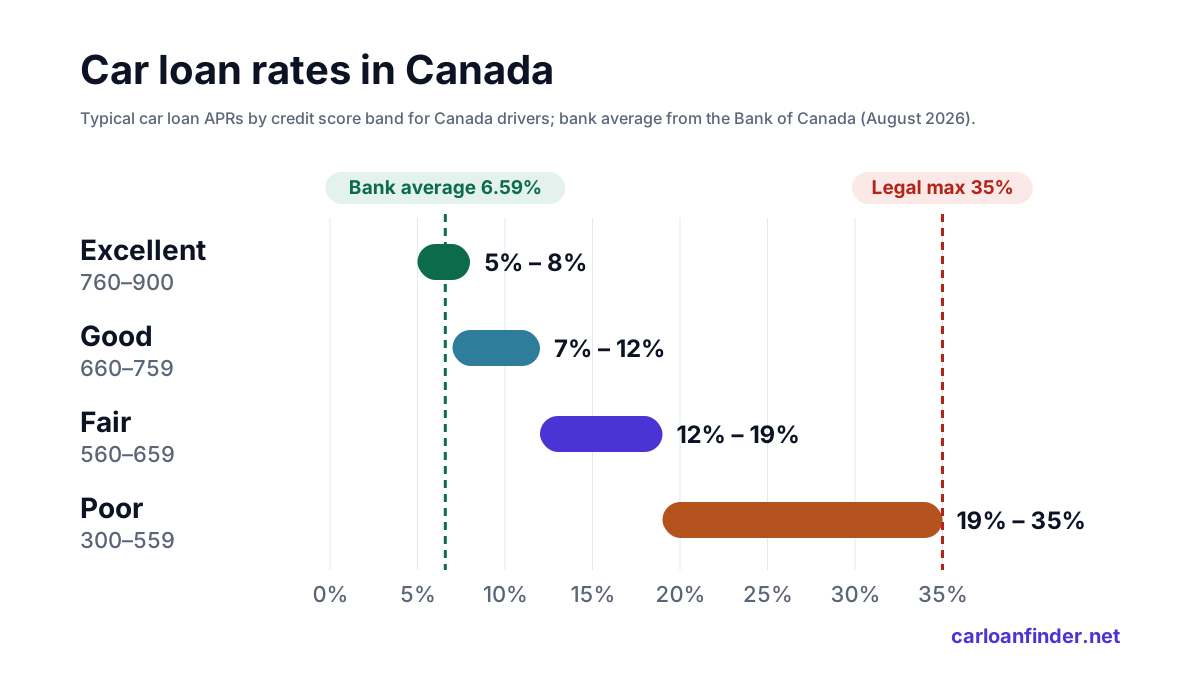
Rates vary widely by credit band. Equifax estimates 7–12% for good credit, 12–19% for fair and 19–35% for poor, while chartered banks averaged 6.59% on new auto loans in August 2026, according to the Bank of Canada. On $25,000 over 48 months, that range means a payment of $594 at the bank average, $628 at a good rate of 9.50%, $702 at a fair rate of 15.50% and $857 at a poor rate of 27.00%.
Term is the other lever. At the bank average, stretching $25,000 from 60 to 84 months adds about $1,863 in interest, and the extra grows with the rate. Ask each lender for the same term so you compare like with like, then decide separately whether a longer term is worth its cost.
Warning signs worth walking away from
Be cautious when a seller talks only about the weekly or monthly payment and avoids the rate or the total. The same applies when optional products, such as extended service contracts or payment protection, appear in the contract without being discussed. Ask for each add-on to be priced separately and remove any you do not want.
Any rate above 35% is illegal: the Criminal Code has capped interest at that level since January 1, 2025. Pressure to sign the same day, blank spaces in the contract or a final rate that differs from the one quoted are all reasons to stop and ask questions. A fair offer will still be there tomorrow, after you have had time to read it.
Car sales in Nova Scotia are covered by provincial consumer protection law. If a dealer misleads you about the price, the rate or the vehicle, contact the provincial consumer protection office. Keep every written quote, as it is your best evidence of what you were promised. Notes on who said what, and when, are useful too.
Insurance and what the loan should do for you
Auto insurance in Nova Scotia is sold by private insurers, so compare several quotes before you choose a vehicle. Lenders need proof of full coverage before you take delivery, and premiums can differ a lot between models, so add the insurance figure to your comparison table rather than discovering it at the end.
Checking your options through Car Loan Finder uses a soft inquiry that does not affect your credit score, so you can see where you stand before a dealer submits a full application. Once you sign, most lenders report on-time payments to the credit bureaus, and a steady record can help you refinance at a lower rate later.
Finally, judge the winning offer against your own budget, not just against the other quotes. The cheapest loan is still the wrong one if the payment leaves no room for insurance, fuel, winter maintenance and an emergency fund. Pick a payment you can make every month without strain, because a single missed payment can undo much of the progress the loan was meant to bring.
Comparing offers is easier when you look beyond a single lot. Dartmouth is only 3 km away, and Cole Harbour (9 km), Bedford (12 km) and Lower Sackville (17 km) are close enough to visit in an afternoon, so ask dealers there for written quotes too. Halifax, the provincial capital, spans 9 postal areas, among them B3H, B3J and B3K, and lenders confirm the address on your application. Wherever you buy in the province, the same 14% HST, private insurance market and consumer protection law apply, which keeps quotes easy to compare.
Questions about this topic
How much HST will I pay on a car in Halifax?
Nova Scotia charges 14% HST, about $3,500 on a $25,000 vehicle. Paying the tax upfront instead of financing it lowers the interest you pay over the loan.
How do I compare two car loan offers in Halifax?
Line up the amount financed, rate, term, monthly payment, fees and total cost of borrowing for each one. Ask both lenders for the same term so the comparison is fair.
What interest rate should I expect with bad credit?
Equifax estimates 12–19% for fair credit and 19–35% for poor credit. No lender can legally charge more than 35%.
Can I buy in Dartmouth or Bedford instead of Halifax?
Yes. Dealers across Nova Scotia charge the same 14% HST and follow the same consumer protection law, so nearby communities simply add more offers to compare.
Who do I contact if a Halifax dealer misleads me?
Car sales in Nova Scotia are covered by provincial consumer protection law. Contact the provincial consumer protection office and keep your written quotes as evidence.
Does checking my options lower my credit score?
No. Car Loan Finder uses a soft inquiry that does not affect your credit score. A hard inquiry is made only when a dealer sends your full application to a lender.