What a lender weighs before saying yes
Your credit score, which runs from 300 to 900, is only the starting point. A score in the poor band tells the lender to look harder at the rest of your file, not to stop reading. The first question is income: is it steady, can it be verified, and how much of it is already committed to rent, credit cards and other loans each month.
Stability comes next. Time at your current job and address suggests the payment will keep arriving. A recent move or job change is not disqualifying, but expect questions and be ready with an offer letter or a lease. Lenders also check whether past problems are behind you, for example whether collections are settled and recent payments have been on time.
Finally, the lender looks at the deal itself. A down payment lowers the amount at risk, and a modest vehicle priced close to its market value is easier to approve than an expensive one. When a file is borderline, these two levers often decide the outcome, which is why it pays to settle your budget before you fall for a particular car.
From soft check to delivery: the approval sequence
The process usually starts with a pre-qualification. Car Loan Finder checks your options with a soft inquiry, which does not affect your credit score, and tells you what kind of financing your profile may support. This lets you shop within a realistic price range instead of applying blind at several dealerships and collecting hard inquiries along the way.
Once you choose a vehicle, the dealer sends a full application to one or more lenders. This is when a hard inquiry is made and the lender asks for documents: recent pay stubs, a void cheque or bank statement, a driver's licence and proof of address. Self-employed buyers should bring recent bank statements and their Notices of Assessment from the Canada Revenue Agency instead of pay stubs.
A conditional approval names the rate, term and any required down payment. The final step is insurance: in Alberta, lenders need proof of full coverage before you take delivery. Only after the contract is signed and the coverage is in place do you get the keys, so leave yourself time to collect quotes rather than accepting the first policy offered.
How your credit band shapes the rate and payment
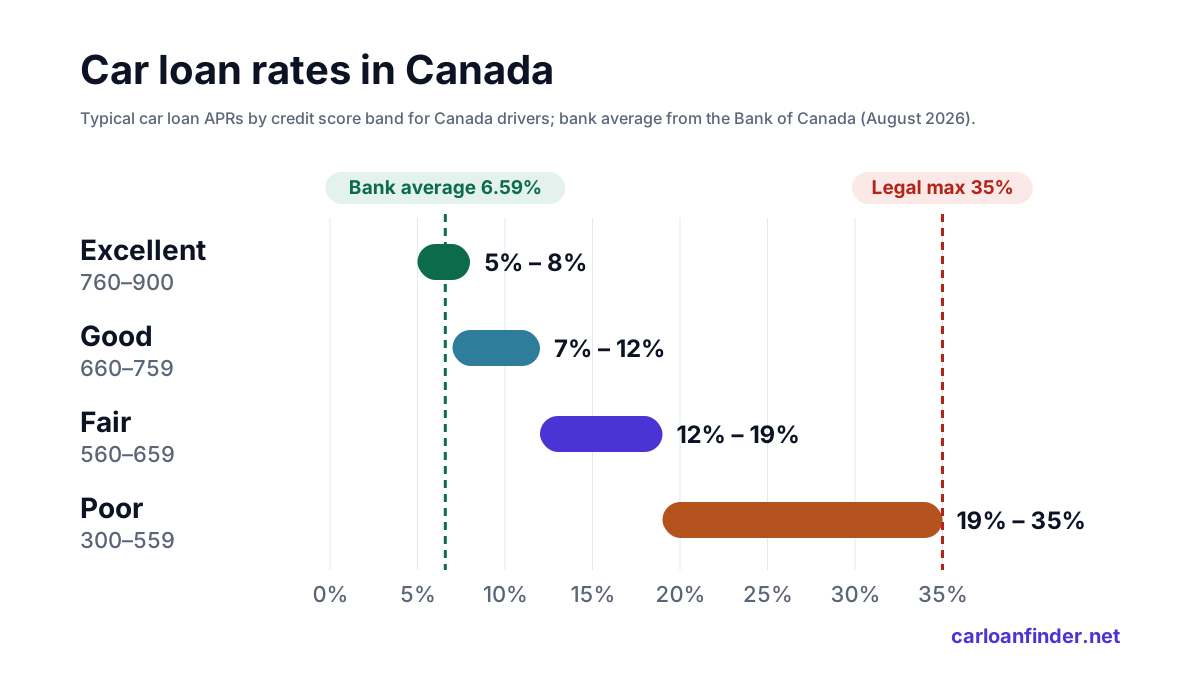
Equifax publishes estimated rate ranges by score band: 5–8% for excellent credit, 7–12% for good, 12–19% for fair and 19–35% for poor. For comparison, the Bank of Canada reports that chartered banks averaged 6.59% on new auto loans in August 2026. No lender can legally charge more than 35%, the criminal rate cap set in the Criminal Code since January 1, 2025.
On a $25,000 loan, the band makes a large difference. At the bank average, 60 months costs about $490 a month. At a fair-credit rate of 15.50% the same loan is $601, and at a poor-credit rate of 27.00% it climbs to $763. Over five years, that gap adds up to thousands of dollars, so even one step up in your score band is worth chasing before or during the loan.
Stretching the term lowers the payment but raises the total. At the bank average, choosing 84 months instead of 60 adds about $1,863 in interest on $25,000, and the gap is wider at higher rates. A good approval is one you can pay every month without strain, at a term you will not regret halfway through.
Signing the contract with confidence
Car dealers in Alberta are regulated by AMVIC (Alberta Motor Vehicle Industry Council). Before you sign, confirm that the dealer holds a licence, and keep the regulator's contact details in case something goes wrong after the sale. A licensed dealer must give you a clear contract showing the price, the rate and every fee.
Read the total cost of borrowing, not just the monthly figure. Ask which add-ons are optional, such as service contracts or payment protection, and remove any you do not want. Remember that Alberta charges only the 5% GST on a vehicle, about $1,250 on a $25,000 purchase, so a quote showing a larger tax line deserves a question.
Once you drive away, the loan starts working for you. Most lenders report on-time payments to the credit bureaus, so a year of steady payments can lift your score and put a lower rate within reach when you refinance or buy your next vehicle. Set up automatic withdrawals on payday and keep your other accounts current so nothing undoes that progress.
Shopping around Calgary gives you plenty of room to compare. Whether you live in Rundle, Whitehorn or another part of the city, dealers in Calgary and in surrounding communities including Chestermere (19 km), Airdrie (28 km), Cochrane (31 km) and Okotoks (36 km) can all submit to the same specialist lenders, so a better deal may be a short drive away. The city spans 36 postal areas, among them T1Y, T2A and T2B, and lenders will verify the address you give against your documents. Whichever dealer you pick, AMVIC licensing and the 5% GST apply the same way.
Questions about this topic
Can I get a car loan in Calgary with a credit score under 560?
Yes, many specialist lenders finance scores in the poor band, which Equifax places between 300 and 559. Expect rates in the 19–35% range and a lender that pays close attention to your income and down payment.
Will checking my options hurt my credit score?
No. Car Loan Finder checks your options with a soft inquiry that does not affect your credit score. A hard inquiry happens only when a dealer submits your full application to a lender.
What documents do Calgary lenders usually ask for?
Most ask for recent pay stubs, a driver's licence, proof of address and a void cheque or bank statement. Self-employed buyers usually provide bank statements and Notices of Assessment from the Canada Revenue Agency.
How much is the sales tax on a car in Calgary?
Alberta charges only the 5% GST, with no provincial sales tax. On a $25,000 vehicle that comes to about $1,250.
Do I need a down payment with bad credit?
It is not always required, but it often decides a borderline file. A down payment reduces the amount the lender has at risk and can bring a lower rate or a shorter term within reach.
Who do I contact if a Calgary dealer misleads me?
Car dealers in Alberta are regulated by AMVIC (Alberta Motor Vehicle Industry Council). Check the dealer's licence before signing and contact AMVIC if something goes wrong.