Route 1: Go back to your bank or credit union
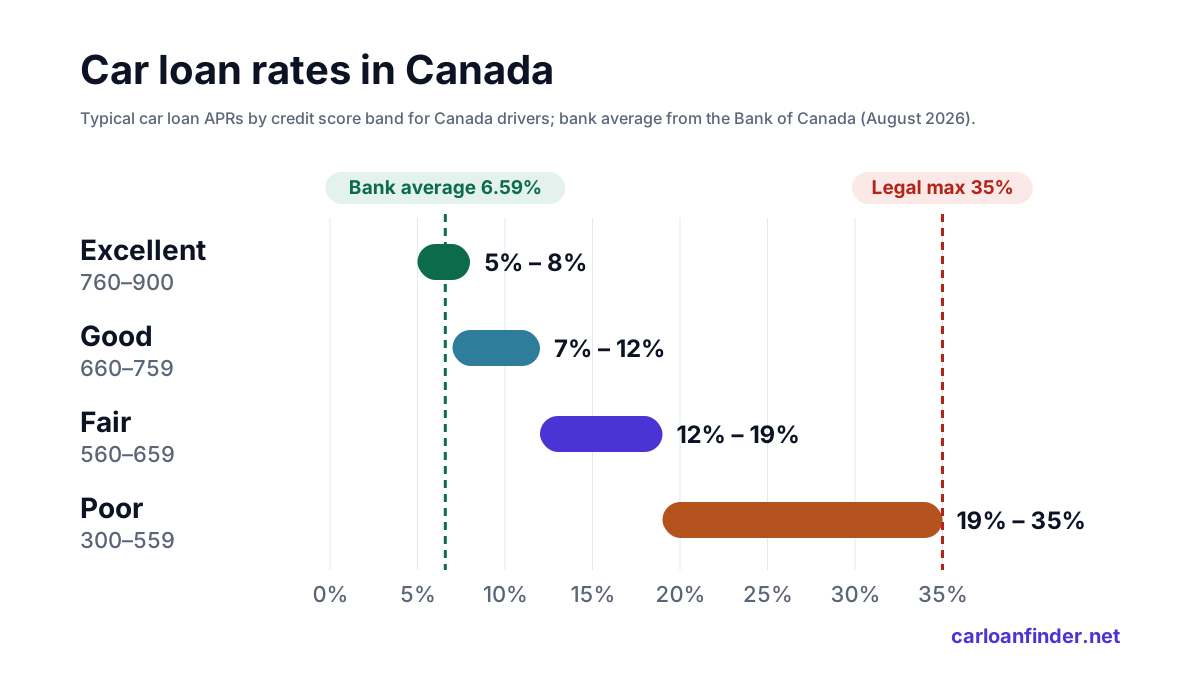
If your score sits near the fair band, roughly 560 to 659 on the Equifax scale, and your problems are a few years old, your own financial institution may still lend. It already knows your deposits and payment history, which counts for something. Chartered banks averaged 6.59% on new auto loans in August 2026, according to the Bank of Canada, so even a rate a few points higher would be a good result.
To give the application its best chance, pay down revolving balances, bring proof of steady income and ask for a modest amount. If the bank still declines, ask why. The answer, whether it is a high debt load, a recent late payment or too short a job history, tells you exactly what to fix or what to explain to the next lender.
A bank loan also tends to come with fewer add-ons and a simpler contract. The downside is speed and flexibility: banks rarely bend their rules for a recent missed payment, and a decline adds a hard inquiry to your file. Apply to one institution at a time rather than several at once, and move to another route if the answer is no.
Route 2: Finance through a dealer that works with specialist lenders
Many dealers send applications to lenders that specialise in bad or thin credit. These lenders weigh income, employment and stability more heavily than the score, and they often approve files a bank would not. The trade-off is price: Equifax estimates 12–19% for fair credit and 19–35% for poor credit, and the Criminal Code caps any loan at 35% since January 1, 2025.
This route suits buyers who need a vehicle soon and can handle a higher payment for a while. On $25,000 over 72 months, a poor-credit rate of 27.00% means $704 a month, compared with $535 at a fair rate of 15.50%. Before you visit, check your options through Car Loan Finder, which uses a soft inquiry that does not affect your credit score.
Car dealers in Ontario are regulated by OMVIC (Ontario Motor Vehicle Industry Council). Confirm that the dealer is registered, ask for the rate and total cost in writing, and contact OMVIC if something goes wrong after the sale. Read every line of the contract and remove optional products, such as extended service contracts, that you did not ask for.
Route 3: Strengthen the file with a co-signer or down payment
A co-signer with good credit and steady income can move you into a lower rate band. It is a serious commitment for that person, who becomes fully responsible if you stop paying, so only ask someone who understands the risk and whose own budget can absorb it. The difference can be large: on $25,000 over 48 months, $857 a month at 27.00% drops to $702 at 15.50%.
A down payment works in a similar way without involving anyone else. Ontario charges 13% HST, about $3,250 on a $25,000 vehicle, and covering at least that amount upfront means you are not paying interest on the tax. After a bankruptcy or consumer proposal, or with no credit history, a meaningful down payment is often what turns a maybe into a yes.
Whichever lever you use, insurance belongs in the budget from the start. Auto insurance in Ontario is sold by private insurers, so compare several quotes, and remember that lenders need proof of full coverage before you take delivery. A lower rate gained through a co-signer is soon lost if the insurance on your chosen model is far higher than expected.
Route 4: Rebuild first, then buy
If your current car still runs and nothing forces a purchase, a few months of rebuilding can save a lot. Pay every bill on time, keep card balances low and check your credit report for errors. A first bankruptcy usually stays on your Equifax report for 6 years after discharge, and a consumer proposal until 3 years after you complete it, but scores often start improving well before those dates.
Use the waiting time to save. Every dollar saved is a dollar you will not borrow, and a stronger file may give you a choice of routes 1 to 3 instead of only one. When you are ready, compare offers on the same term so the total cost is clear. Most lenders report on-time payments to the credit bureaus, so once you do buy, a payment you can always make keeps the rebuilding going.
Starting the search from Kingston, you can add dealers in Glenburnie (10 km) and Westbrook (12 km), or travel to Gananoque (28 km) or Napanee (37 km) for more choice. The city has 4 postal areas, K7K, K7L, K7M and K7P, with neighbourhoods such as Downtown, Cataraqui, Collins Bay and Reddendale, and lenders will match the address on your application to your documents. Kingston is about 241 km from Toronto, Ontario's largest city, yet the same rules follow you anywhere in the province: 13% HST, private auto insurance and dealers registered with OMVIC.
Questions about this topic
Can I get a car loan in Kingston after a bankruptcy?
Yes, specialist lenders can approve you before a bankruptcy leaves your Equifax report, which usually happens 6 years after discharge for a first bankruptcy. A down payment improves your chances and your rate.
Is it better to finance through my bank or a dealer?
If your credit is close to the fair band, try your bank first, since its rates are usually lower. If it declines, a dealer that works with specialist lenders can often find an approval, at a higher rate.
Does a co-signer really lower the rate?
It often does, because the lender can rely on the co-signer's credit and income too. The co-signer becomes fully responsible for the loan if you miss payments.
Should I look at dealers in Gananoque or Napanee?
Comparing dealers in nearby communities gives you more offers to choose from. The same 13% HST and OMVIC rules apply throughout Ontario.
How do I check insurance costs before buying in Kingston?
Auto insurance in Ontario is sold by private insurers, so ask several for quotes on the models you are considering. Lenders need proof of full coverage before you take delivery.
Will checking my options affect my credit score?
No. Car Loan Finder uses a soft inquiry that does not affect your credit score. A hard inquiry is made only when a lender receives your full application.