Step 1: Work out the payment you can carry
List your take-home pay and every fixed cost: rent, utilities, phone, debt payments and groceries. What remains has to cover the car payment, insurance, fuel, parking and maintenance, with a cushion left for repairs and winter tires. If the cushion disappears, the payment is too high, no matter what a lender is willing to approve.
Get insurance quotes early, because they can change the answer. Auto insurance in Ontario is sold by private insurers, so compare several quotes, and remember that lenders need proof of full coverage before you take delivery. A model that costs much more to insure may push an otherwise affordable loan past your limit.
Write the final number down and treat it as a ceiling, not a target. Dealers often present a payment slightly above what you asked for, framed as only a few dollars more a week. Small increases add up over a long term, so decide in advance that you will say no, and bring a printed copy of your budget to keep the conversation grounded.
Step 2: Know what your credit band costs
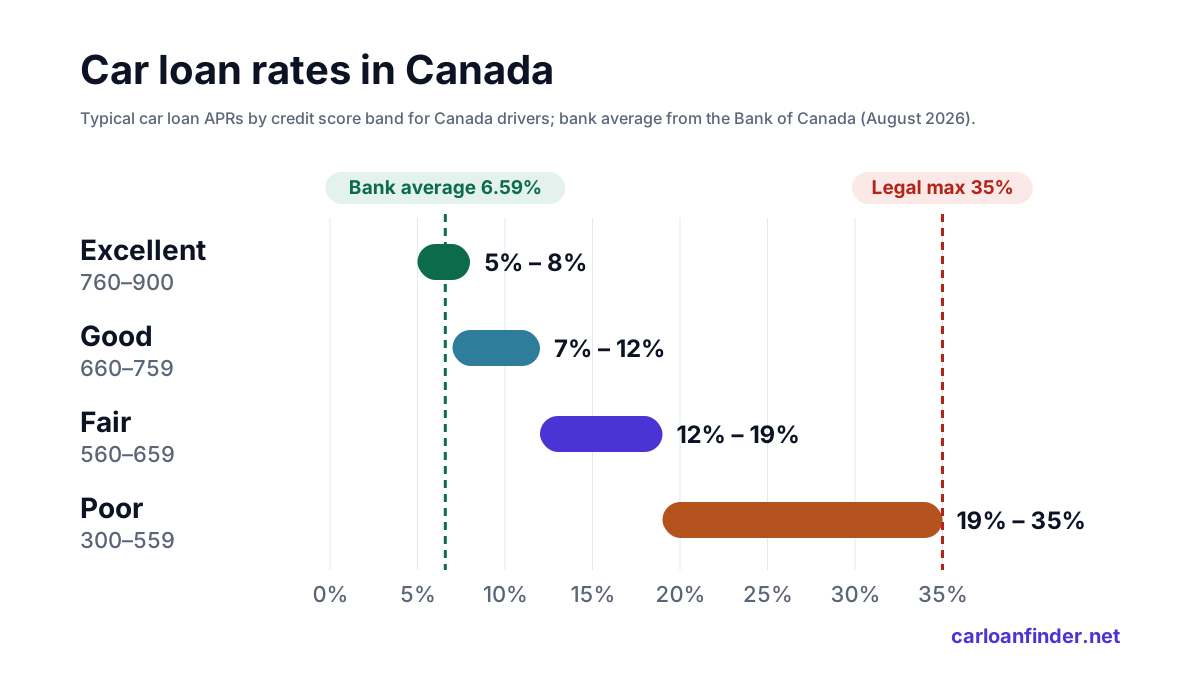
Equifax publishes estimated rate ranges by score band: 5–8% for excellent credit, 7–12% for good, 12–19% for fair and 19–35% for poor. The Bank of Canada reports that chartered banks averaged 6.59% on new auto loans in August 2026, and the Criminal Code has capped interest at 35% since January 1, 2025, so no legal offer can go higher.
To see what this means in dollars, take $25,000 over 84 months. The payment is $372 at the bank average, $409 at a good rate of 9.50%, $489 at a fair rate of 15.50% and $665 at a poor rate of 27.00%. Find your band, compare its payment with the limit from step 1, and you will know quickly how much car your budget can support.
Step 3: Choose the shortest term you can afford
A longer term lowers the payment but raises the total cost. At the bank average, stretching $25,000 from 60 to 84 months adds about $1,863 in interest, and at subprime rates the gap is much wider. Long terms also leave you owing more than the car is worth for longer, which makes an early trade-in expensive.
Start with the shortest term whose payment fits your limit. At a fair-credit rate of 15.50%, for example, $25,000 costs $601 a month over 60 months and $535 over 72. If the shorter term is within reach, the savings in interest are real; if it is not, consider a less expensive vehicle before reaching for the longest term on offer. The lower payment on the longer term looks modest, but it comes with a full extra year of payments.
Step 4: Cut the balance before you borrow
Every dollar you do not borrow is a dollar you do not pay interest on. Ontario charges 13% HST on a vehicle, about $3,250 on a $25,000 purchase, and financing that tax means paying interest on it for years. A down payment or trade-in that covers the tax is a practical first target.
A down payment also strengthens a borderline file. It reduces the lender's risk and can bring a lower rate or a shorter term within reach. If you have recently come out of a bankruptcy or consumer proposal, or have no credit history at all, a larger down payment or a co-signer is often what moves a lender from no to yes.
Step 5: Compare across the area and close safely
Before visiting dealers, check your options through Car Loan Finder. It uses a soft inquiry that does not affect your credit score, so you can see what you may qualify for without collecting hard inquiries. Then ask two or three dealers, in the city or nearby communities, for written quotes on the same term so you can compare total cost.
Car dealers in Ontario are regulated by OMVIC (Ontario Motor Vehicle Industry Council). Check that the dealer is registered before you sign, read every line of the contract, remove add-ons you do not want and contact OMVIC if something goes wrong. Once you drive away, most lenders report on-time payments to the credit bureaus, which helps you rebuild.
Check what you are signing for, too. Make sure the vehicle identification number, price, rate, term and payment on the contract match the quote you accepted. Ask about prepayment: many loans let you pay extra or pay off early, which is the quickest way to cut interest once your budget has room. Keep copies of everything until the loan is fully paid off.
Hamilton gives you a wide area to shop. Stoney Creek, Dundas and Hannon are each about 8 km from the city, with Waterdown (10 km), Ancaster (12 km) and Burlington (15 km) also close, so you can compare several dealers before committing. The city covers 17 postal areas, including L8E, L8G and L8H, and neighbourhoods such as Riverdale, McQuesten and Hamilton Beach; lenders will check the address on your application. Hamilton is about 62 km from Toronto, Ontario's largest city, and the same OMVIC rules and 13% HST apply wherever you buy in the province.
Questions about this topic
What monthly payment should I expect on a bad credit car loan in Hamilton?
On $25,000 over 72 months, the payment is about $535 at a fair-credit rate of 15.50% and $704 at a poor-credit rate of 27.00%. Your exact payment depends on the rate, the term and how much you put down.
Is an 84-month car loan a good idea with bad credit?
It lowers the payment but raises the total interest considerably. At the bank average, 84 months instead of 60 adds about $1,863 on $25,000, and the gap grows at higher rates.
How much HST will I pay on a car in Hamilton?
Ontario charges 13% HST, about $3,250 on a $25,000 vehicle. Covering it with a down payment avoids paying interest on the tax.
Should I shop in Burlington or Stoney Creek as well?
Comparing dealers in nearby communities gives you more offers to choose from. The same 13% HST and OMVIC rules apply throughout Ontario.
Who regulates car dealers in Hamilton?
Car dealers in Ontario are regulated by OMVIC (Ontario Motor Vehicle Industry Council). Check the dealer's registration before you sign and contact OMVIC if something goes wrong.
Will checking my options hurt my credit score?
No. Car Loan Finder checks your options with a soft inquiry that does not affect your credit score. A hard inquiry happens only when a dealer submits your full application to a lender.