Step 1: Find your score band and set a payment ceiling
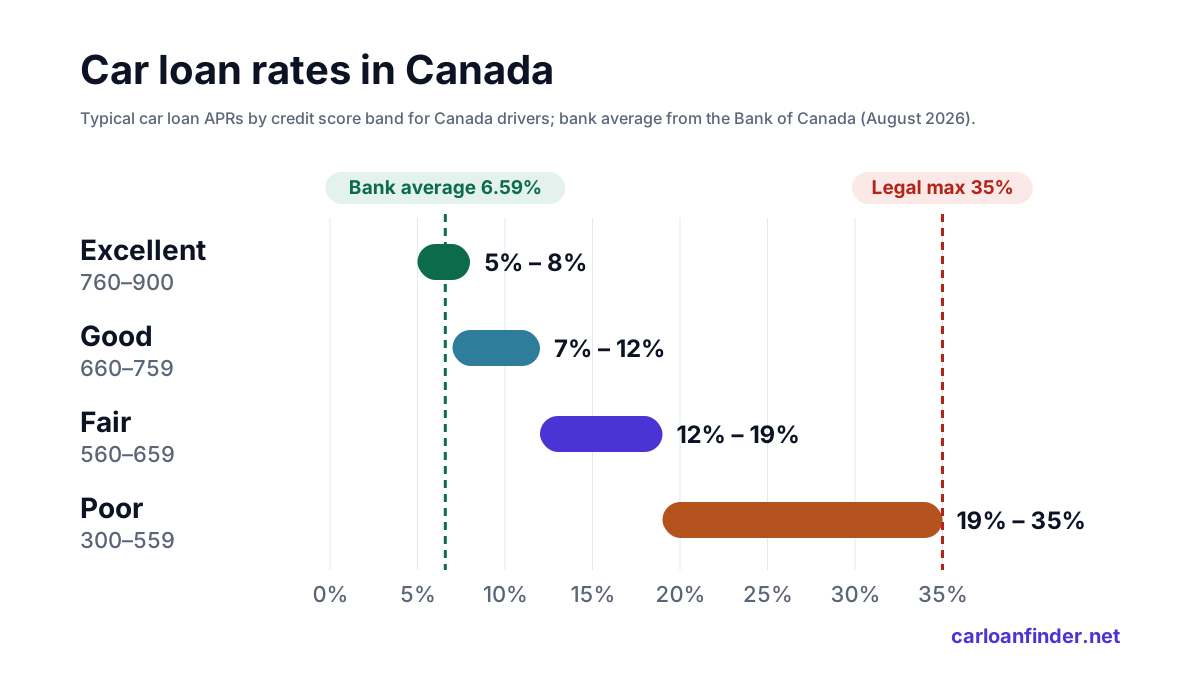
Start with your credit report, not the car. Equifax scores run from 300 to 900, and published estimates link each band to a typical rate: about 5–8% for excellent credit, 7–12% for good, 12–19% for fair and 19–35% for poor scores below 560. Knowing your band before you apply tells you which offers are reasonable and which have been padded.
Next, decide the most you can pay each month and treat it as a hard limit. On $25,000, a fair-credit rate of 15.50% works out to about $601 a month over 60 months, while a poor-credit rate of 27.00% is about $704 over 72 months. At the bank average of 6.59%, the same loan costs about $490 a month over 60 months, which shows what rebuilding your score is worth.
Leave room for insurance, fuel, maintenance and parking when you set that ceiling. A payment that only fits when nothing goes wrong is the one most likely to be missed, and a missed payment undoes the progress the loan was meant to build.
Step 2: Put your paperwork and ICBC quote together
Lenders who work with damaged credit lean on documents, because the score alone says little about what you can repay. Expect to show government photo ID, a valid driver's licence, recent pay stubs, proof of address and a void cheque or banking details for automatic payments. Having everything scanned and ready means your file is never held up waiting on you.
If you are self-employed, bring recent bank statements and your Notices of Assessment from the Canada Revenue Agency in place of pay stubs. If you are new to Canada or have never borrowed, lenders weigh income, employment and residency instead of a score, and a larger down payment or a co-signer widens your options.
Get your ICBC quote early. Basic coverage in British Columbia comes from ICBC, the public insurer, and no lender will release the vehicle until proof of coverage is in place. Knowing the premium before you shop keeps you from agreeing to a payment you cannot carry once insurance is added.
Step 3: Check your options, then compare offers line by line
Checking options through Car Loan Finder uses a soft inquiry, so it does not affect your credit score. Car Loan Finder is not a lender; it matches you with lenders and dealers that handle bad, fair or no credit. Ask for every offer in writing, because a rate quoted out loud on the lot can change once the paperwork is drawn up.
Line the offers up side by side and look past the monthly payment. Compare the interest rate, the term, the total of all payments, any fees and whether add-ons such as extended service contracts have been rolled in. Stretching a $25,000 loan at the bank average from 60 to 84 months adds about $1,863 in interest, and the gap grows at higher rates.
Under the Criminal Code, no lender can charge more than 35% APR, a cap in force since January 1, 2025. An offer close to that ceiling is legal, but it is a signal to bring a larger down payment, add a co-signer or choose a less expensive vehicle before accepting.
Step 4: Sign safely and use the loan to rebuild
Before you sign, confirm the dealer is licensed with the Vehicle Sales Authority of British Columbia (VSA). Read the contract in full, check that the price, rate and term match the offer you accepted, and never sign a page with blank fields. If a dealer misrepresents a deal, the VSA is where to take the complaint.
Once you drive away, the loan becomes a credit-building tool. Most lenders report on-time payments to the credit bureaus, so scheduling automatic payments for payday is the simplest safeguard. After a solid stretch of clean history, ask whether refinancing at a lower rate makes sense; a lender will judge the improved file, not the old one.
Richmond buyers have more choice than they might expect. Vancouver, the province's largest city, is about 9 km away, Delta about 11 km and Burnaby about 17 km, so written offers from several dealers can be compared without a long trip. The city's eight postal areas run from V6V to V7E and take in Sea Island. Budget for 5% GST plus 7% PST, about $3,000 on a $25,000 vehicle, and note that PST climbs above 7% on pricier passenger vehicles. Winter tires are required on most designated BC highways from October 1 to April 30, so check DriveBC for your routes.
Questions about this topic
Can I get a car loan in Richmond after being declined by my bank?
Often, yes. Specialist lenders look at income, job stability and your budget as well as your score. Expect a rate above the bank average of 6.59%, and compare several written offers before choosing.
Will checking my options lower my credit score?
No. Car Loan Finder checks options with a soft inquiry, which does not affect your score. A lender you later choose to apply with may run a full credit check.
How much tax will I pay on a car bought in Richmond?
British Columbia charges 5% GST plus 7% PST, about $3,000 on a $25,000 vehicle. PST on passenger vehicles rises above 7% at higher purchase prices, so ask for the full tax figure in writing.
Do I need insurance before I pick up the car?
Yes. Lenders require proof of coverage before delivery, and basic coverage in BC comes from ICBC. Get your quote early so the premium is part of your budget from the start.
What is the highest interest rate a lender can charge?
The Criminal Code caps interest at 35% APR, a limit in force since January 1, 2025. Published estimates put poor-credit car loans at 19–35%, so a high offer may be legal and still worth negotiating.
Can I shop for a car outside Richmond?
Yes. Vancouver is about 9 km away and Delta about 11 km, so comparing dealers across the region is practical. Whichever dealer you choose should be licensed with the VSA.