Where you are in the process changes your options
Lenders treat three situations differently. If you are still in an undischarged bankruptcy, borrowing is hardest: you must tell any lender about your bankruptcy, and your trustee will look at whether a new payment fits your surplus income obligations. Few lenders will approve a car loan at this stage unless the vehicle is essential for work.
A consumer proposal is viewed more favourably. You are repaying part of your debts on a schedule, and many specialist lenders will consider you once a few months of proposal payments are on record. Once your bankruptcy is discharged or your proposal is complete, the door opens wider, and each month of clean history after that point makes the next lender a little more comfortable.
The record does not disappear at discharge. A first bankruptcy usually stays on your Equifax report for 6 years after discharge, and a consumer proposal stays until 3 years after you complete it. You do not have to wait for those dates, since specialist lenders can approve you sooner, often with a down payment, but knowing when the notation drops off helps you time a refinance.
What a lender wants to see after insolvency
Bring proof that the insolvency is behind you or on track: a certificate of discharge, a certificate of full performance for a finished proposal, or your trustee's statement showing proposal payments are up to date. Lenders also ask for recent pay stubs or bank statements, proof of address and a valid driver's licence. Self-employed borrowers should add Notices of Assessment from the Canada Revenue Agency.
Stability matters more than your score at this point. A steady job, the same address for a while and a bank account without overdrafts all reassure a lender. A down payment, even a small one, shows you can save and lowers the amount at risk. Some borrowers add a co-signer, but only ask someone who understands they will owe the full balance if you stop paying.
Realistic rates and how to keep the cost down
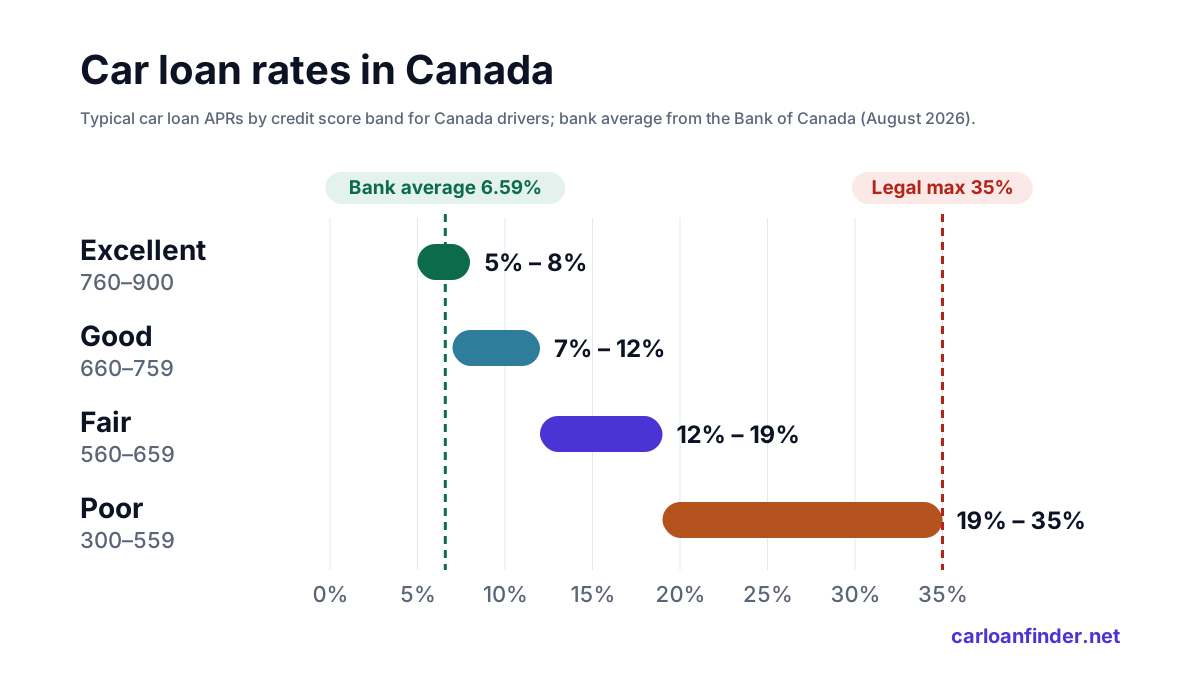
Equifax scores run from 300 to 900, and a recent insolvency usually places you in the Poor band of 300–559, where published estimates put car loan rates between 19%–35%. For comparison, the average rate on new auto loans at chartered banks was 6.59% in August 2026. Since January 1, 2025, the Criminal Code caps lending at 35% APR, so any offer above that is illegal.
At these rates, the size and length of the loan matter more than anything else. Choose a dependable used car rather than the vehicle you would have bought before, borrow as little as possible and pick the shortest term your budget allows. Avoid rolling an old loan balance into the new one, and say no to add-ons you do not need, since each one is financed at the same high rate.
Using the loan to rebuild, then refinancing
A car loan is an instalment account, and most lenders report on-time payments to the credit bureaus. After insolvency, that steady record is one of the clearest ways to show you have changed course. Set up automatic payments timed to your payday and check your credit report a few months in to confirm the account is being reported correctly.
Do not treat your first rate as permanent. After a year or more of on-time payments, with your discharge or proposal further behind you, ask your lender for a lower rate or compare refinancing offers from other lenders. Before signing, confirm the contract allows early repayment without a heavy penalty, so you are free to refinance when your credit improves.
Insolvency itself is federal law, but much of what happens to your car depends on where you live. Each province sets its own exemptions, so whether you can keep a vehicle through a bankruptcy, and up to what value, differs from one province to the next; your trustee can tell you what applies to you. When you buy again, the sales tax on the purchase also depends on your province, as does insurance: some provinces run a public insurer for basic coverage. In Quebec, winter tires are required from Dec 1 to Mar 15, a cost worth adding to your first-year budget.
Questions about this topic
Can I get a car loan while I am still bankrupt?
It is possible but difficult, because you must disclose the bankruptcy and your trustee will review whether you can afford a new payment. Most borrowers find more options after their discharge or once a consumer proposal is under way.
Is it easier to get financing in a consumer proposal than in bankruptcy?
Usually, yes. Lenders see a proposal as an effort to repay, and many specialist lenders will consider you after a few months of on-time proposal payments.
Will I lose my current car if I file for bankruptcy?
Not necessarily. Provincial exemptions decide how much vehicle value you can keep, and a financed car can often be kept if you continue the loan payments, so ask your trustee before you file.
What interest rate should I expect after a discharge?
Many borrowers start in the Poor score band, where published estimates range from 19%–35%. Your income, down payment and the time since discharge can move an offer toward the lower end, and no legal loan can exceed the 35% APR cap.
Does checking my options hurt my credit score?
Car Loan Finder checks options with a soft inquiry, which does not affect your credit score. A lender will run a hard check only when you apply for a specific loan.
How soon can I refinance a post-bankruptcy car loan?
Many borrowers look at refinancing after a year or more of on-time payments. Check your contract for prepayment penalties first, and compare the new rate and fees against what you would save.