Step 1: Set a budget before you shop
Start with the monthly amount you can spend on the car as a whole, not just on the loan. Insurance, fuel, maintenance, tires, registration and parking all come out of the same budget. The Financial Consumer Agency of Canada's guide to financing a car walks through these ownership costs, and a payment that only works if nothing ever breaks is a payment that is too high.
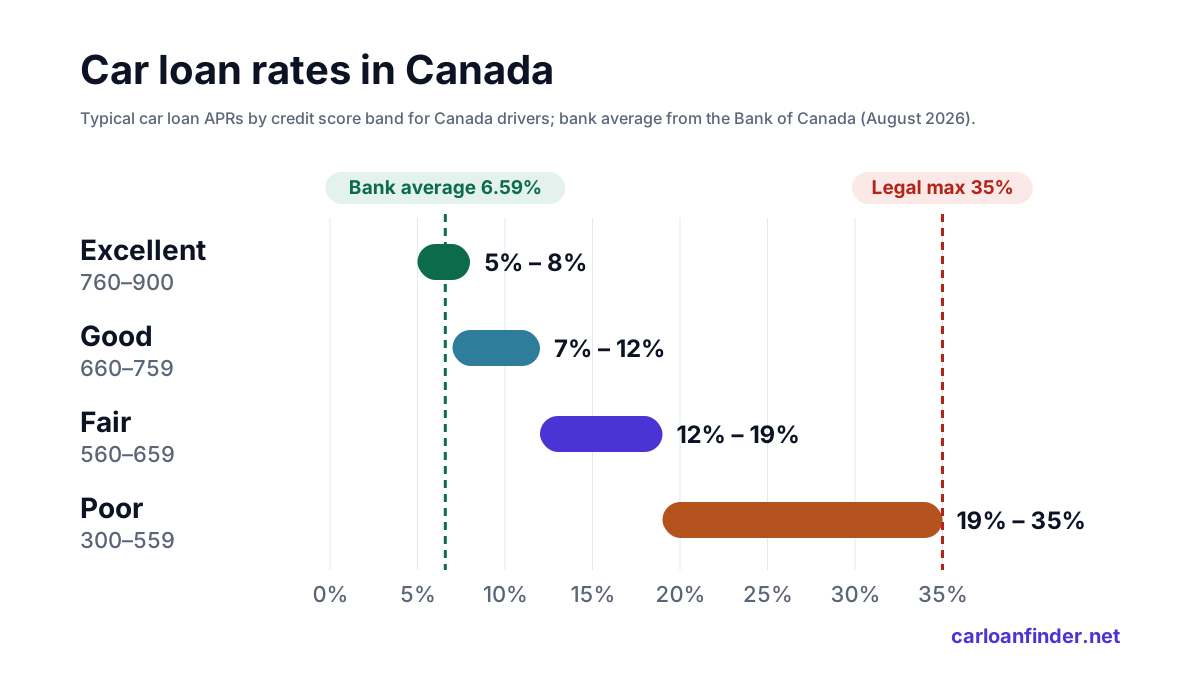
Then decide on a term and a price range together. A shorter term costs less interest but raises the payment; a longer term does the reverse. The Bank of Canada reports an average rate of 6.59% on new auto loans at chartered banks (August 2026), but your own rate depends on your credit, so build the budget around a rate that fits your score band rather than the average.
Set aside a down payment if you can. Even a modest amount lowers what you borrow and the interest you pay, and it gives you room if a lender asks for money down as a condition of approval. Keep a separate cushion for the first insurance payment and the registration, which are due before or soon after you take the car home.
Step 2: Check your credit and compare lenders
Get your credit reports and know your score before anyone else pulls it. Canadian scores run from 300 to 900, and published estimates by Equifax score band put Excellent credit (760–900) at 5%–8%, Good (660–759) at 7%–12%, Fair (560–659) at 12%–19% and Poor (300–559) at 19%–35%. Correct any errors you find before you apply, since a mistake can cost you a band.
Then compare sources of financing. A bank or credit union can quote a loan directly, dealers arrange financing through several lenders, including the car makers' own finance companies, and subprime lenders handle files that banks decline. A pre-approval before you shop tells you how much you can borrow and gives you a rate to measure the dealer's offer against.
Limit hard inquiries while you compare. Applying at many places at random leaves a trail of them on your report. Car Loan Finder is not a lender; it checks your options with a soft inquiry that does not affect your credit score, so you can see which lenders may consider your profile before you choose where to apply formally.
Step 3: Choose the car and gather your documents
With a budget and a pre-approval in hand, shop for the vehicle and negotiate its price before you discuss financing at the dealership. Keep the price, the trade-in value and the loan as separate conversations, so a lower payment is not hiding a higher price or a longer term. For a used car, ask for a vehicle history report and an independent inspection.
Take your time at this stage. A pre-approval usually stays valid for a set period, so you do not need to decide on the first visit. Test-drive more than one vehicle, compare insurance quotes for each, and walk away from any deal where the seller will only discuss the monthly payment rather than the price of the car.
Lenders will ask for documents before they fund the loan. Expect government-issued photo ID and your driver's licence, proof of income such as recent pay stubs or, if you are self-employed, notices of assessment, proof of address, and banking details for the payments. You also need insurance on the car before you take delivery, so get quotes early.
Step 4: Read the contract, then sign
The contract is where everything you negotiated becomes binding. Check the vehicle details, the price, the amount financed, the APR, the term, the payment and the total cost of borrowing. Make sure every fee and add-on product is one you agreed to, and remember that products such as extended service contracts and payment insurance are optional.
Look for the rules on paying the loan off early and whether a penalty applies. Confirm the APR is within the law: since January 1, 2025, the Criminal Code has set the criminal interest rate at 35% APR, fees included. If anything differs from the offer you accepted, ask for it to be corrected before you sign, and keep a copy of every page.
After signing, set up automatic payments and keep them on time. Most lenders report on-time payments to the credit bureaus, so a car loan handled well can strengthen your file for the next one and may let you refinance at a lower rate later. Keep the contract and your payment records together in case you need them.
A few steps depend on your province. Sales tax is GST or HST alone in some provinces and GST plus a provincial sales tax in others, so the same car can cost a different total depending on where you register it. Insurance comes from a public insurer in a few provinces and from private insurers in the rest, and you need proof of coverage before you drive away. In Quebec, winter tires are required from December 1 to March 15, which belongs in the budget for any car bought there.
Questions about this topic
How do I get a car loan in Canada?
Set a budget, check your credit, compare lenders and get a pre-approval, then choose the car, gather your documents and review the contract before signing. A bank, a credit union, a dealer or a subprime lender can provide the financing.
What documents do I need for a car loan in Canada?
Lenders usually ask for photo ID and a driver's licence, proof of income such as pay stubs or notices of assessment, proof of address and banking details. You also need proof of insurance before you take delivery.
What is the average car loan interest rate in Canada?
The Bank of Canada reports an average rate of 6.59% on new auto loans at chartered banks (August 2026). Your own rate depends on your credit, and published estimates by Equifax score band run from 5%–8% for Excellent credit to 19%–35% for Poor credit.
Is it better to finance a car through the bank or the dealer?
Either can cost less depending on your credit and any promotions on the car. Get a pre-approval from a bank or credit union first so you can compare it with the dealer's offer on APR and total cost.
Can I get a car loan in Canada with bad credit?
Subprime lenders specialise in applications with scores in the Fair or Poor bands, at higher rates than banks charge. A down payment, verified income and a realistic choice of vehicle improve your chances.
Can I pay off a car loan early in Canada?
Many loans allow early repayment, but the terms vary, so check the contract for any penalty before you sign. Paying the loan off early reduces the total interest you pay.