Excellent and good credit: 660 to 900
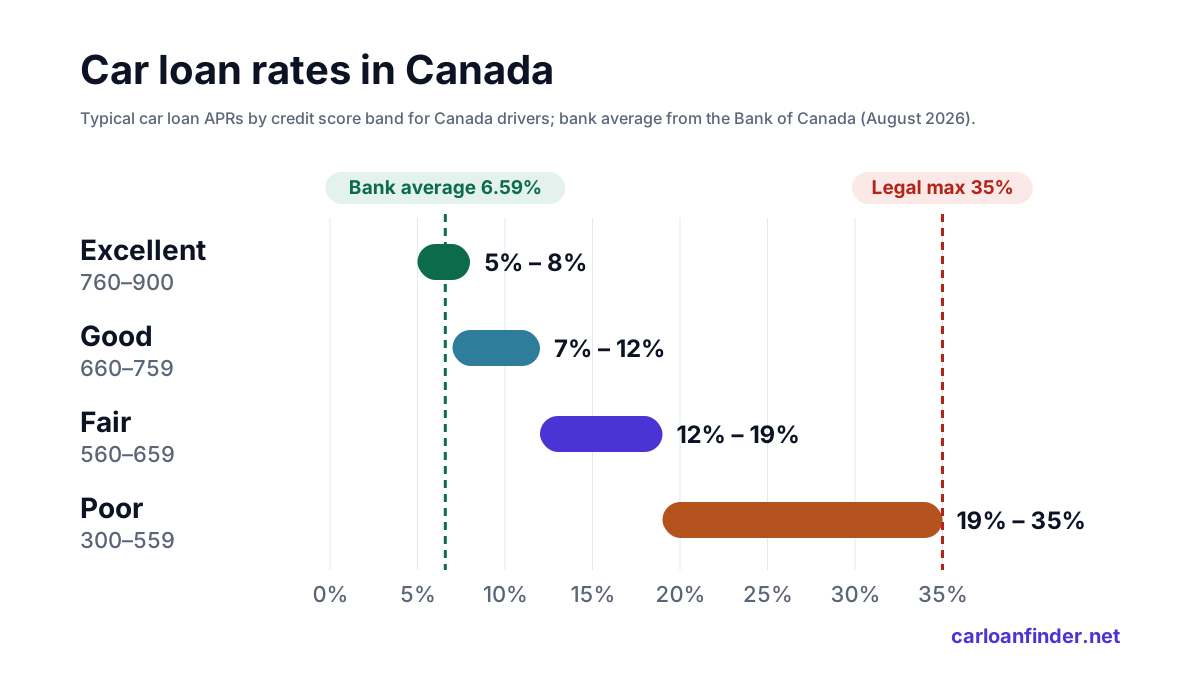
Borrowers with excellent credit (760–900) are the ones banks, credit unions and manufacturer finance programs compete for. Published estimates put their rates at 5%–8%, close to the chartered-bank average of 6.59% for new auto loans in August 2026. For comparison, the Bank of Canada's policy rate was 2.25% and the prime rate 4.45% in October 2026.
Good credit (660–759) still opens most doors, with estimates of 7%–12%. The difference within this tier often comes down to details: a stable job, a modest debt load and a down payment. If you are near the top of the range, compare a bank's offer with the dealer's financing, since either can come out ahead. At this level, the main risk is overspending rather than being declined. Choose a term that keeps the total interest reasonable instead of the longest term on offer.
Fair credit: 560 to 659
Fair credit is where many Canadians first meet a declined bank application. Published estimates for this tier run from 12%–19%, and lenders look more closely at income, employment and how long you have lived at your address. Specialist lenders and dealer finance programs are often the main options.
Small changes can move your rate a long way within this tier. A larger down payment, a less expensive vehicle or a co-signer with established credit all reduce the lender's risk. Bring recent pay stubs or, if you are self-employed, your Notices of Assessment and bank statements, so the lender judges your real income rather than your score alone. Compare at least two written offers on the APR, the term and the total repaid, not on the monthly payment alone.
Poor credit: 300 to 559
A score below 560, often after missed payments, a consumer proposal or a bankruptcy, places you in the poor tier, where published estimates range from 19%–35%. The ceiling is set by law: the Criminal Code caps interest at 35% APR since January 1, 2025, so any quote above it is not a legal loan.
Approval is still possible, but the terms matter more than ever. Specialist lenders usually ask for proof of steady income and often a down payment. Keep the vehicle modest and the term as short as your budget allows, because high rates make long terms expensive. Read the contract carefully for fees and add-ons that raise the amount financed, and say no to any you do not need.
Moving up a tier
The loan you take today can lift you into a better tier later. Most lenders report on-time payments to the credit bureaus, so a payment you can always make is the most dependable way to rebuild. Check your credit report for errors, keep other balances low and avoid applying for new credit while the car loan is young.
Once your score improves, ask your lender whether refinancing is possible, or compare a fresh offer against what you pay now; a move from the poor tier to the fair tier can change the rate you are quoted. Start by checking your options through Car Loan Finder, which is not a lender and uses a soft inquiry that does not affect your score.
Your credit tier travels with you, but the cost of a car does not. Sales tax depends on the province: some charge a single harmonized sales tax, while others add a provincial tax to the federal GST, and the Canada Revenue Agency publishes the rate for each. Basic auto insurance is sold by a public insurer in British Columbia, Saskatchewan and Manitoba, while Quebec pairs a public injury plan with private insurers, and other provinces rely on private insurers alone. In Quebec, winter tires are required from Dec 1 to Mar 15. Budget for all of it before you choose a payment.
Questions about this topic
What credit score do I need to finance a car in Canada?
There is no single minimum. Lenders serve every tier from 300 to 900, but the rate and conditions change sharply as the score falls.
What interest rate can I expect with fair credit?
Published estimates for fair credit (560–659) run from 12%–19%. Income, down payment and the vehicle all influence where you land within that range.
What is the average car loan rate at Canadian banks?
The Bank of Canada reports an average of 6.59% on new auto loans at chartered banks in August 2026, and 6.83% on existing auto loans. Borrowers with lower scores usually pay more.
Can a lender charge more than 35% on a car loan?
No. The Criminal Code sets the criminal interest rate at 35% APR since January 1, 2025. An offer above it is not legal.
Will checking my financing options hurt my credit score?
Not with Car Loan Finder, which uses a soft inquiry. A hard inquiry happens only when you formally apply with a lender.
How can I move from poor to fair credit faster?
Make every payment on time, keep other balances low and avoid new credit applications for a while. Most lenders report on-time payments to the credit bureaus, which helps your score recover.