Why approval can never be promised
A car loan is a lender's bet that you will pay it back. To make that bet, a lender has to look at what you earn, what you already owe, how long you have been in your job and home, and what the car is worth. Until that review happens, there is nothing to approve. An ad that says otherwise is describing a sales pitch, not a lending decision.
Read the fine print on these offers and you will usually find conditions: proof of income, a minimum deposit, a vehicle chosen by the dealer, or approval subject to credit review. In other words, the promise disappears at exactly the moment you need it. The ad brought you through the door; the real terms only appear once you have spent time and emotion on a particular car.
That does not mean people with damaged credit cannot get financed. Some lenders specialize in borrowers with fair or poor credit, and a well-prepared application can succeed. The difference is that an honest lender tells you what it needs and what the loan will cost, rather than promising an outcome it has not yet earned the right to promise.
Red flags in sure-thing offers
The clearest warning sign is a fee before approval. A lender that asks for an application fee, an insurance deposit or a processing charge by e-transfer or gift card before giving you a written offer is a reason to walk away. Legitimate lenders explain their fees in the loan contract, and you should never pay to be told whether you qualify.
Pressure is another signal. Watch for a deal that is only available today, a salesperson who will not let you take the contract home, or blank spaces you are asked to sign now and have filled in later. Be wary, too, of anyone who suggests rounding up your income on the application. That is misrepresentation, and the consequences fall on you, not on the person who suggested it.
Finally, look at how the offer is described. If you can get a monthly payment but nobody will tell you the interest rate, the term or the total cost of borrowing, the payment is being used to hide something. Ask for each figure in writing; a lender confident in its offer will not hesitate to put it on paper.
What really decides a lender's answer
Income comes first. Lenders want to see that the payment fits comfortably beside your rent, other loans and living costs, and they will ask for pay stubs, bank statements or tax documents to prove it. Stability matters as well: time at the same job and the same address suggests the income will continue for the length of the loan.
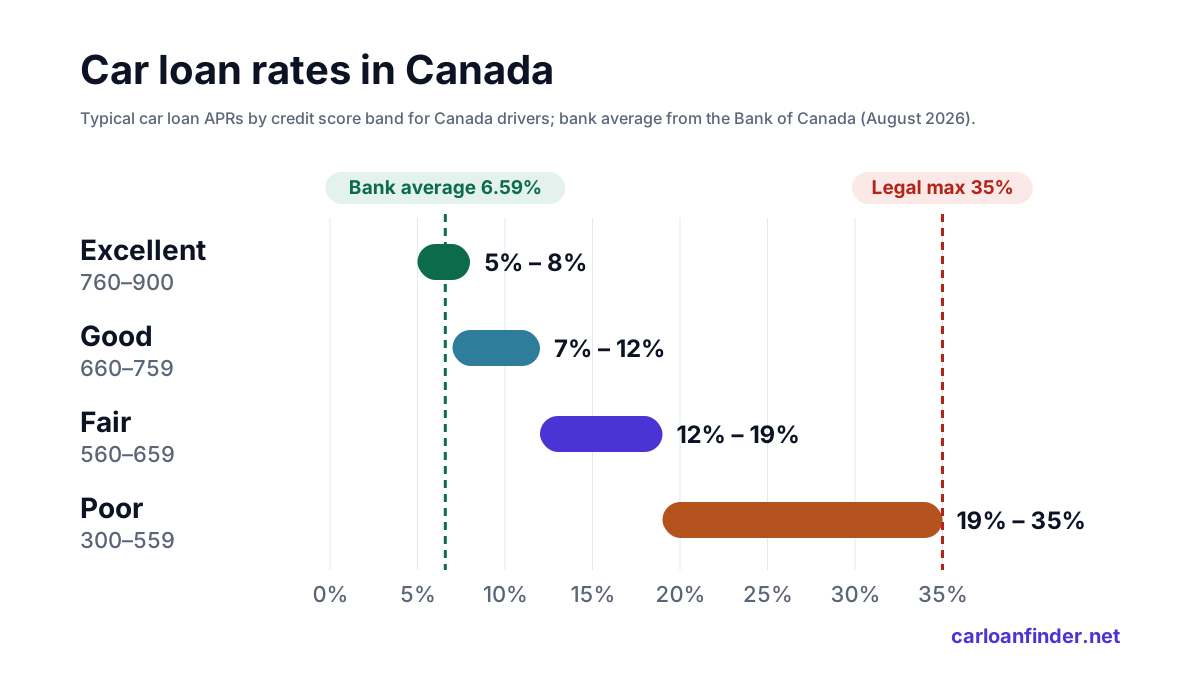
Your credit history sets the price more than the answer. Published estimates by Equifax score band put excellent credit (760–900) at about 5%–8%, good credit (660–759) at 7%–12%, fair credit (560–659) at 12%–19%, and poor credit (300–559) at 19%–35%. Scores in Canada run from 300 to 900, and each band up can lower your cost noticeably.
The vehicle and the structure of the deal are the last pieces. A reliable, reasonably priced car is easier to finance than one that stretches your budget. A deposit, a trade-in with equity or a co-signer with stronger credit can each reduce the lender's risk, and they are often what turns a no into a yes, at a cost you can actually carry.
How to test an offer before you sign
Start with the annual percentage rate. Since January 1, 2025, the Criminal Code has capped interest at 35% APR, so any offer close to that level deserves a second look. For context, the Bank of Canada reported average rates of 6.59% on new auto loans and 6.83% on existing auto loans at chartered banks in August 2026.
Then ask for the total cost of borrowing: everything you will pay over the term beyond the price of the car. Compare offers on that number and on the term, not on the payment. The Financial Consumer Agency of Canada's guidance on financing a car walks through the same checks and is worth reading before a dealership visit.
You can also see your likely options before any lender pulls your full file. Car Loan Finder is not a lender; it checks options with a soft inquiry that does not affect your credit score. That way, the first real offer you look at is based on your own profile, not on a promise printed on a banner.
Before you compare an advertised payment with your budget, check what it leaves out. Sales tax is set by province, as GST with a provincial tax in some places and a single HST in others; the Canada Revenue Agency lists the rates. Insurance comes from a public insurer in some provinces and from private companies elsewhere, so the quote depends on where you live. Quebec drivers also need winter tires from December 1 to March 15. None of these costs disappear because an ad says approval is certain.
Questions about this topic
Can any lender promise to approve my car loan?
No honest lender can promise approval before reviewing your income, debts, credit history and the vehicle. Ads that suggest otherwise usually attach conditions in the fine print. Treat the promise as marketing and judge the written offer instead.
Is it normal to pay a fee before being approved?
No. Paying before you receive a written offer, especially by e-transfer or gift card, is a common sign of a scam. Legitimate fees are disclosed in the loan contract.
What interest rate can I expect with bad credit?
Published estimates by Equifax score band put poor credit (300–559) at roughly 19%–35%, and fair credit (560–659) at about 12%–19%. Your rate also depends on income, deposit, vehicle and term.
What is the highest interest rate a car lender can charge?
Since January 1, 2025, the Criminal Code caps interest at 35% APR. An offer near that level is legal but expensive, so compare it carefully with other options.
Does a co-signer improve my chances?
A co-signer with stronger credit and steady income can reduce the lender's risk and may improve the rate you are offered. The co-signer becomes responsible for the loan if you miss payments, so both of you should understand the commitment.
Will checking my options with Car Loan Finder hurt my credit?
No. Car Loan Finder checks options with a soft inquiry that does not affect your credit score. A hard inquiry only happens if you later apply formally with a lender.