What lenders look at when you have no credit history
Credit scores in Canada run from 300 to 900, but a first-time borrower may not have a score at all, or may have one based on a single credit card. Either way, the lender has to judge risk from other information. Expect to be asked for recent pay stubs, how long you have been with your employer, and details of any rent or other regular payments.
Lenders also compare your monthly debts to your income. If a phone plan, a student loan and a credit card already take a large share of your pay, the room left for a car payment is smaller. Paying down a card balance before you apply can improve that picture more quickly than you might expect.
Stability counts with a first-time borrower. A steady job, even at a modest wage, often matters more than a higher income that changes month to month. If you are self-employed or newly hired, bring extra proof such as bank statements or a letter from your employer confirming your position and pay.
Building a first-car budget that holds up
Start with the total monthly cost of owning the car, then work backward to the payment. Insurance for a new driver can be a large line on its own, so get quotes on the specific models you are considering before you shop. Add fuel, parking, maintenance and a cushion for repairs, which matter more as a car ages.
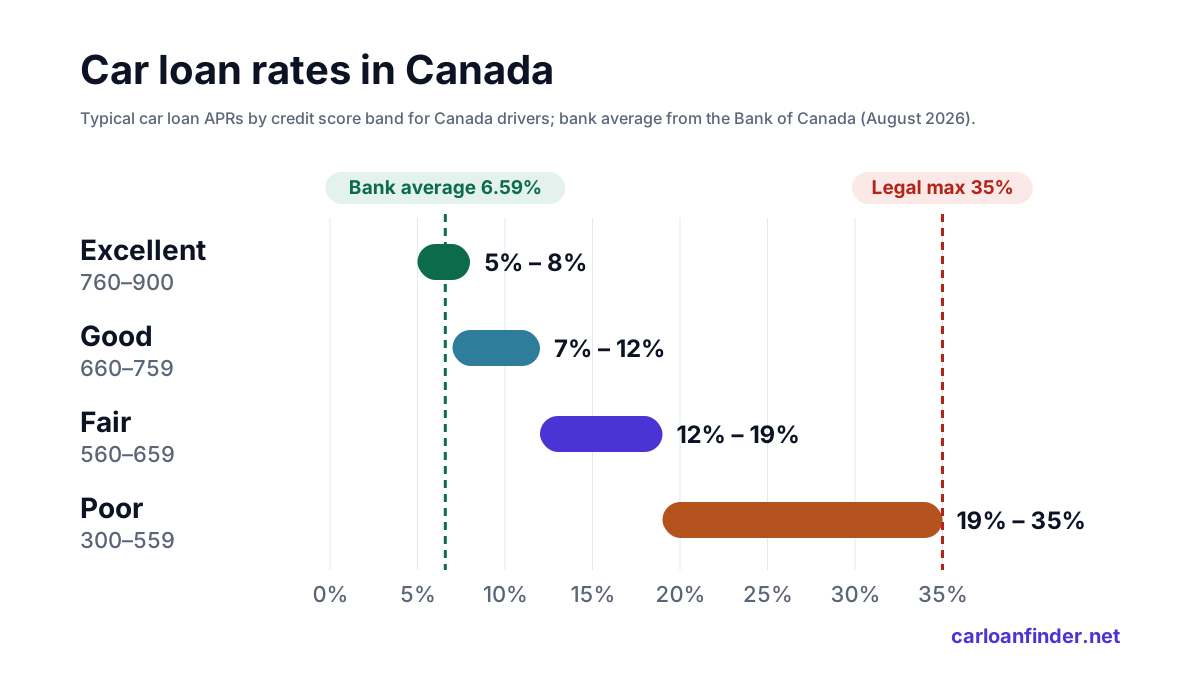
Next, look at rates realistically. Chartered banks averaged 6.59% on new auto loans in August 2026, according to the Bank of Canada, but that average reflects borrowers with established credit. Equifax estimates 12%–19% for fair credit, and a first-time buyer with a thin file may be offered something in between until a payment record exists.
A modest, reliable used car often makes more sense than a new one for a first loan. The amount borrowed is smaller, the payment is easier to carry, and insurance is often lower. Once you have a year or two of on-time payments, your options for the next vehicle usually widen.
Down payments and co-signers
A down payment lowers the amount you borrow and shows the lender you have a stake in the car. For a first-time buyer, it can be the difference between a decline and an approval, and it also reduces the interest you pay. Even a smaller amount saved over a few months helps, as does a trade-in if you have one.
A co-signer is someone with established credit who agrees to repay the loan if you do not. That promise can open the door to an approval or a lower rate. It is a serious commitment for them: missed payments can affect their credit too, and the debt counts against their own borrowing.
If you use a co-signer, treat the arrangement as temporary. Make every payment on time, and once your own credit is established, ask whether the loan can be refinanced in your name alone. Most lenders report on-time payments to the credit bureaus, which is how your first loan starts building your own credit file.
Shopping your first loan without hurting your credit
Before visiting dealers, find out roughly what you qualify for. Car Loan Finder is not a lender; it checks your options with a soft inquiry that does not affect your credit score. Knowing your likely range keeps you from falling for a car whose payment only works on a very long term.
When you get offers from a dealer or lender, compare the annual percentage rate, the term and the total cost of borrowing rather than the monthly payment alone. Read the contract for fees and any add-ons included in the amount financed. If something is unclear, ask, and do not sign until you understand it.
Watch for rates that seem far out of line. Since January 1, 2025, the Criminal Code caps the interest rate on loans at 35% APR, and offers near that level deserve a second look. A first loan you can comfortably repay is worth far more to your credit than a stretch that ends in missed payments.
Where you live in Canada changes the cost of that first car more than the loan itself. Provinces set their own sales tax, either a single HST or GST plus a provincial tax, at rates published by the Canada Revenue Agency. Basic insurance comes from a public insurer in some provinces and from private companies in others, and new drivers usually pay more either way. In Quebec, winter tires are required from Dec 1 to Mar 15, an extra cost to plan for in your first year.
Questions about this topic
Can I get a car loan with no credit history in Canada?
Yes, many lenders work with first-time borrowers, though the rate may be higher until you have a payment record. A steady income, a down payment or a co-signer improves your chances.
What documents do I need for my first car loan?
Lenders usually ask for government photo ID, a driver's licence, proof of income such as recent pay stubs, and proof of address. Self-employed buyers may need bank statements or tax documents.
How much should a first-time buyer put down on a car?
There is no fixed amount, but any down payment reduces what you borrow and the interest you pay. It also makes a thin credit file look less risky to a lender.
Is it better to buy new or used for my first car loan?
A reliable used car usually means a smaller loan, a lower payment and often cheaper insurance. That makes it easier to keep up with payments while you build credit.
Will a co-signer's credit be affected if I miss payments?
Yes. A co-signer is equally responsible for the debt, so late or missed payments can show up on their credit report as well as yours.
Does checking my car loan options lower my credit score?
A soft inquiry, like the one Car Loan Finder uses, does not affect your score. A full application with a lender usually involves a hard inquiry, which can have a small effect.