How lenders see new and used cars
To a lender, the car is the security behind the loan. A new car has a known value and a full manufacturer warranty, so it is easy to price. A used car's value depends on its age, mileage and condition, and that uncertainty often shows up as a slightly higher rate. Many lenders also set a maximum age or mileage, and some decline vehicles beyond it.
New cars sometimes come with promotional financing from the manufacturer's finance arm, which can undercut bank rates for buyers with strong credit. Those offers usually require good or excellent credit and may only apply to certain models or shorter terms. If your score is in the fair or poor range, compare the promotion with a cash discount, since you may not qualify for the advertised rate.
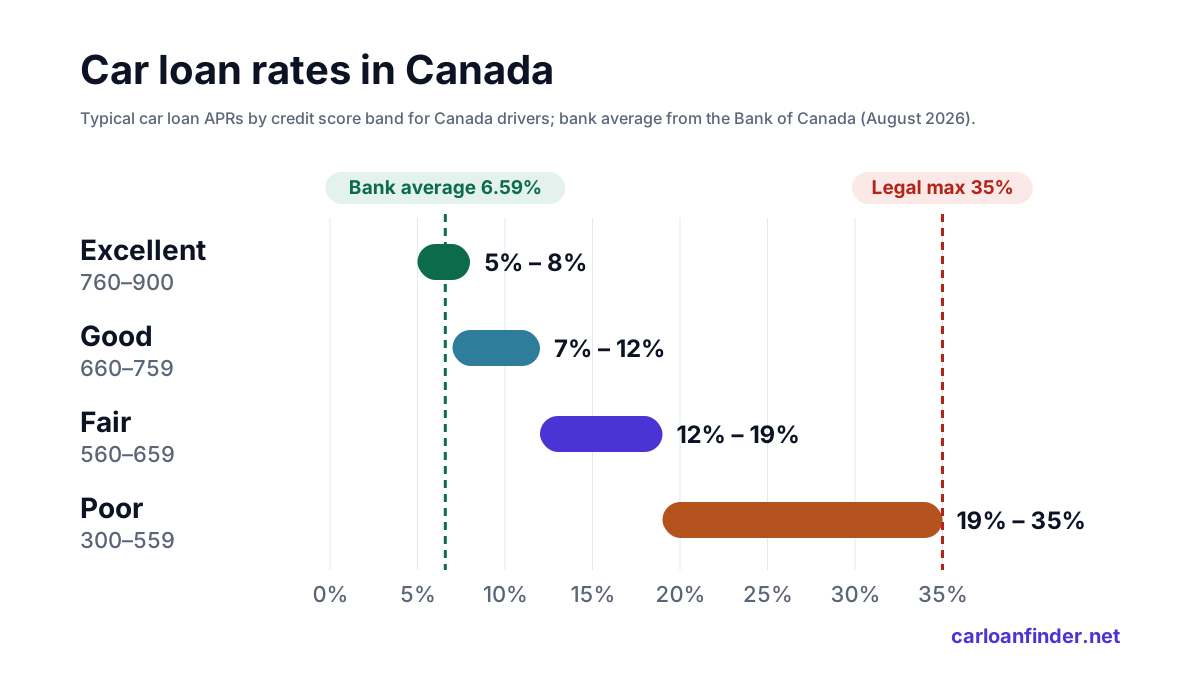
The tier you fall into matters for both kinds of car. Published estimates by Equifax score band put excellent credit (760–900) at about 5%–8% and fair credit (560–659) at 12%–19%. For reference, the Bank of Canada reported an average of 6.59% on new auto loans at chartered banks in August 2026. Whichever car you pick, moving up a credit tier before you buy can lower the cost of the loan noticeably, so it is worth checking your report first.
Depreciation and the risk of owing too much
A new car loses a large share of its value in the first years of ownership. If you finance most of the price over a long term, the balance can stay above the car's value for much of the loan. That is called negative equity, and it becomes a problem the moment you need to sell, trade or replace the car after an accident.
A used car has already taken much of that early drop, so its value tends to decline more slowly. A loan on a reasonably priced used car can reach the point where you owe less than the car is worth sooner. That gives you more flexibility if your plans change, and it means a trade-in later is more likely to help rather than hurt.
A deposit narrows the gap on either kind of car. So does a shorter term. If you are choosing between a new car on a long term and a used car on a shorter one at a similar payment, the used car will often leave you in a stronger position at the end, as long as it is mechanically sound.
Financing a used car the right way
Dealers can arrange financing on the spot, which is convenient, but compare their offer with what you can get on your own. Buying privately usually means arranging the loan yourself first, and some lenders are more cautious about private sales. Either way, know your rate before you negotiate the price, so the two discussions stay separate.
Before you commit, confirm that nobody else has a claim on the car. A vehicle bought with an outstanding lien can be seized to settle the previous owner's debt, so run a lien search through your province's registry and ask for a vehicle history report. Dealers should provide this information; in a private sale, it is up to you.
Always have an independent mechanic inspect a used car before you sign. A repair bill in the first months of a loan is the fastest way for a sensible purchase to go wrong. If the inspection turns up problems, use them to negotiate the price down or walk away and keep looking.
Choosing with fair or poor credit
When your credit is fair or poor, the size of the loan matters as much as the rate. Published estimates by Equifax score band put poor credit (300–559) at 19%–35%. At those rates, every extra dollar borrowed is expensive, so a modest, reliable used car often produces a payment you can carry without stretching the term.
A smaller loan is also easier to get. Lenders weigh the payment against your income, and a lower price leaves more room in that calculation. Since January 1, 2025, the Criminal Code has capped interest at 35% APR, but staying well below that ceiling depends largely on borrowing less and putting money down.
Think of the first loan as a stepping stone. Most lenders report on-time payments to the credit bureaus, and a better score can open the door to a newer car on better terms later. To see your options first, Car Loan Finder checks them with a soft inquiry that does not affect your credit score; Car Loan Finder is not a lender.
Some costs follow you whichever car you choose. Sales tax applies to dealer sales across the country, as GST with a provincial tax or as a single HST depending on the province, and the Canada Revenue Agency lists each rate; how tax applies to a private used-car sale also varies by province, so check before you agree on a price. Insurance comes from a public insurer in some provinces and private companies in others. In Quebec, any car on the road needs winter tires from December 1 to March 15.
Questions about this topic
Is it harder to finance a used car than a new one?
Not necessarily, but lenders look closely at a used car's age, mileage and value. Some set limits beyond which they will not lend, and rates on older vehicles can be somewhat higher.
Do used car loans have higher interest rates?
They often do, because the car's value is less certain. Your credit tier usually has a bigger effect: published estimates by Equifax score band range from about 5%–8% for excellent credit to 19%–35% for poor credit.
Is a new car better if I have bad credit?
Usually not. A new car means a larger loan, and promotional rates generally require strong credit. A reliable used car keeps the loan smaller and easier to manage.
Can I finance a car bought from a private seller?
Yes, some lenders finance private sales, though they may ask for more documents about the car. Arrange the loan before you meet the seller, and run a lien search.
What is negative equity?
It means you owe more on the loan than the car is worth. It happens most often with new cars on long terms, and it becomes a problem if you sell or trade the car early.
Does checking my options affect my credit score?
Not with Car Loan Finder, which checks options with a soft inquiry that does not affect your credit score. A hard inquiry only happens when you formally apply with a lender.