Soft check versus hard check
A soft inquiry lets a company see a summary of your credit file without leaving a mark that other lenders count against you. It happens when you check your own score, when an existing creditor reviews your account, or when a service matches you with possible lenders. Car Loan Finder works this way: checking your options uses a soft inquiry that does not affect your credit score.
A hard inquiry happens when you formally apply and a lender pulls your full report to make a decision. It is recorded on your file and can lower your score slightly for a while. Several hard inquiries close together can make you look like you are scrambling for credit, which is why it pays to narrow your choices before you sign any application.
Canadian credit scores run from 300 to 900. Knowing where you sit before you shop tells you which offers are realistic. The Financial Consumer Agency of Canada explains how to request your credit report at no charge, and reading it first lets you spot errors, such as a debt you already paid, that could be pulling your score down.
Why lenders that skip the check charge more
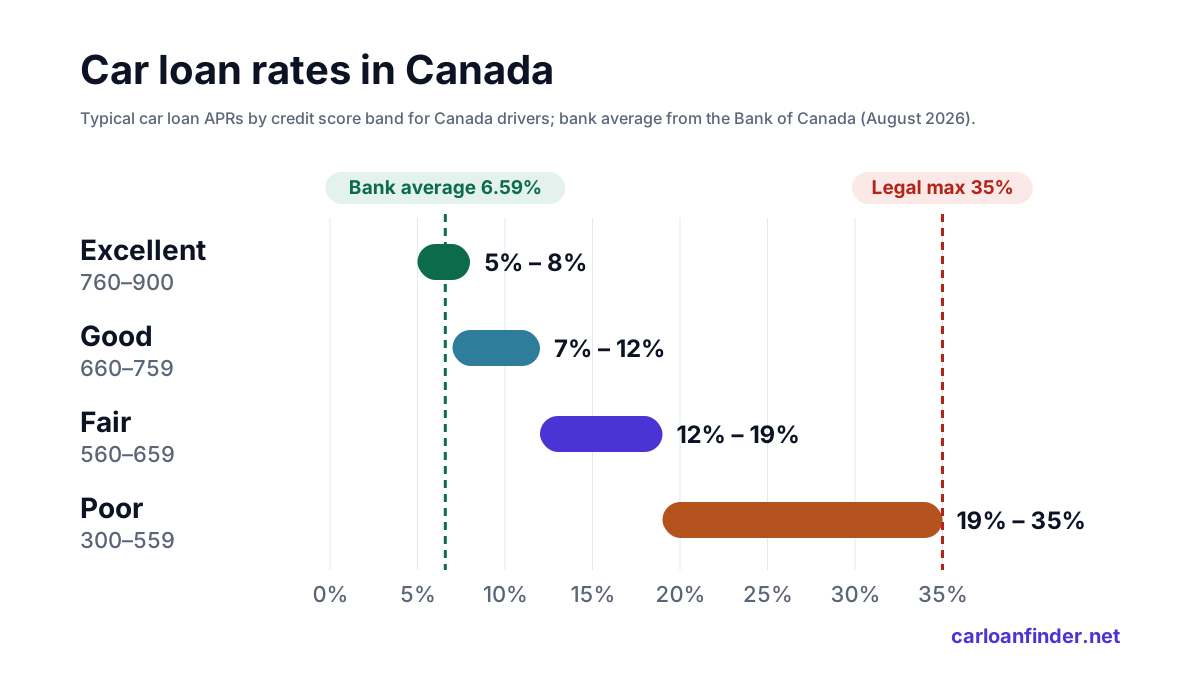
A lender that never looks at your history cannot tell a borrower who missed one payment from one who walked away from three loans. To protect itself, it assumes the worst and prices every applicant that way. That usually means a rate near the top of what the law allows, and in Canada the Criminal Code has capped interest at 35% APR since January 1, 2025.
Compare that with the published estimates by Equifax score band. Borrowers in the poor band (300–559) see roughly 19%–35%, while the fair band (560–659) sits around 12%–19%. If your score is fair, a lender that refuses to check it may charge you as if it were poor, and you would never know. That gap is paid every month for the whole term.
These lenders also protect themselves in other ways: a larger required deposit, an older vehicle chosen from their own lot, a tracking device on the car, or strict penalties for late payments. Read the contract for repossession terms and fees before you sign, because those clauses can matter more than the monthly payment printed in the ad.
What a bigger deposit really does
The one piece of the old advice that holds up is the deposit. Every dollar you put down is a dollar you do not borrow at a high rate. A larger down payment shrinks the loan, lowers the interest you pay over the term, and reduces the risk of owing more than the car is worth if you need to sell it early.
A deposit also changes how a lender sees you. A borrower who has saved money and has something to lose looks less risky, which can move an offer toward a lower rate or a shorter, cheaper term. Even if you cannot reach the amount you hoped for, saving for a few more months before buying can still make a real difference.
A trade-in works the same way when the vehicle is paid off. If you still owe money on it, ask exactly how the remaining balance is handled: rolling old debt into a new loan raises the amount you finance and can wipe out the benefit of the trade. Ask for the trade-in value and the payout amount in writing.
Safer routes than skipping the check
Start by letting a soft check do the sorting. A service that matches you with lenders through a soft inquiry shows which ones are likely to work with your profile, so you only submit full applications where you have a real chance. That keeps hard inquiries to a minimum while still letting lenders price you on your actual history rather than the worst case.
Next, compare offers on the annual percentage rate and the total cost of borrowing, not on the payment alone. A low payment can hide a very long term. Bring proof of income, such as recent pay stubs or bank statements, and proof of address; complete paperwork can matter almost as much as the score when a lender is deciding.
Finally, treat the loan as a way to rebuild. Most lenders report on-time payments to the credit bureaus, so steady payments can lift your score and open the door to refinancing at a lower rate later. Some lenders that skip the credit check also skip reporting, so ask before you sign: a loan that never reaches your file cannot help you rebuild.
Credit inquiries work the same way in every province, but the total you end up financing does not. Sales tax depends on where you register the car: some provinces charge GST plus a provincial sales tax, others a single HST, and the Canada Revenue Agency publishes the rate for each. Insurance differs too, since some provinces run a public auto insurer while others leave coverage to private companies. In Quebec, winter tires are required from December 1 to March 15, a cost to budget for whichever loan you choose.
Questions about this topic
Can I get a car loan without any credit check?
Some dealers and private lenders advertise loans that skip the credit check, but they still assess risk through your income, your deposit and the vehicle. Expect higher rates and stricter terms in exchange. Most mainstream lenders check credit before approving a loan.
Does checking my options lower my credit score?
Not when it is a soft inquiry. Car Loan Finder uses a soft inquiry to check your options, and that does not affect your credit score. A hard inquiry only happens when you formally apply with a lender.
What interest rate should I expect with poor credit?
Published estimates by Equifax score band put poor credit (300–559) at roughly 19%–35%. For comparison, the Bank of Canada reported an average of 6.59% on new auto loans at chartered banks in August 2026. Your own rate depends on your income, deposit, vehicle and term.
How many hard inquiries are too many?
There is no fixed number, but several hard inquiries in a short period can make lenders cautious. Narrow your options with soft checks first and apply only where your profile is a good fit.
Can a car lender charge more than 35%?
No. Since January 1, 2025, the Criminal Code caps interest at 35% APR. If an offer looks more expensive once fees are added, ask the lender to show how the APR was calculated before you sign.
Will a loan that skipped the credit check help me rebuild?
Only if the lender reports your payments, and some of these lenders do not. Most lenders report on-time payments to the credit bureaus, so ask about reporting before you sign.