Interest rate versus APR
The interest rate is the price of borrowing the money itself. The annual percentage rate, or APR, folds in charges you must pay to get the loan, such as administration or lender fees, and expresses the whole as a yearly rate. When fees are involved, the APR is the more honest figure, and it is the one to use when you compare two offers side by side.
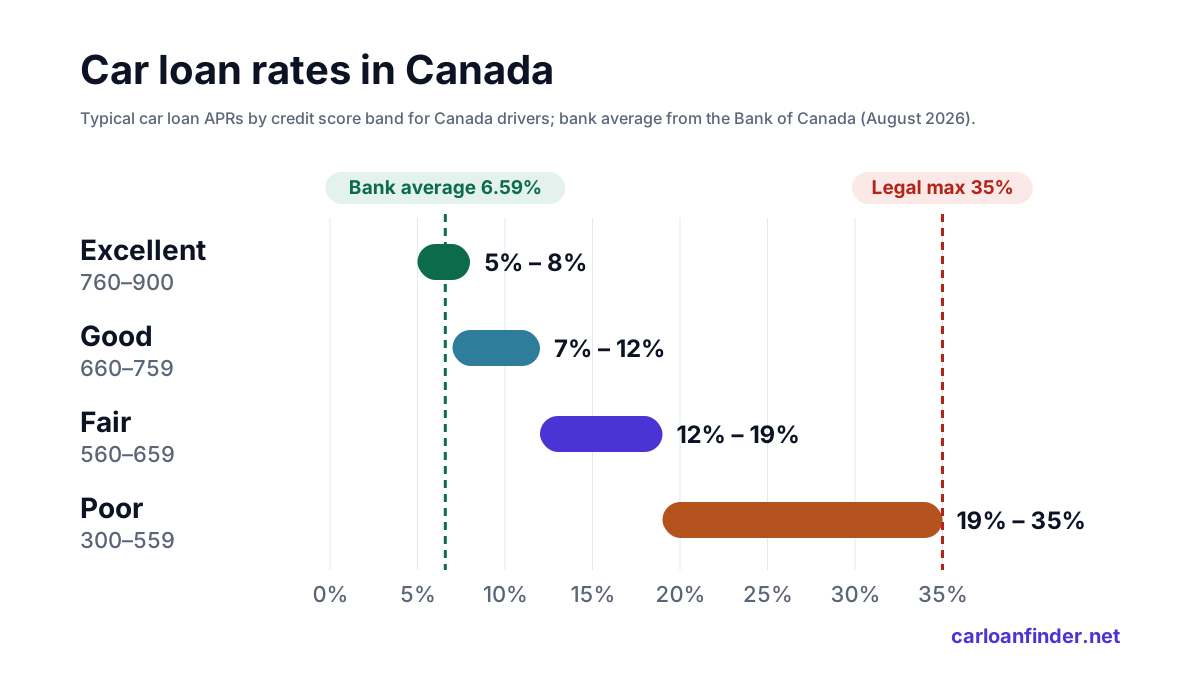
Put the APR in context. The Bank of Canada reports an average rate of 6.59% on new auto loans at chartered banks (August 2026). Published estimates by Equifax score band put Fair credit (560–659) at 12%–19% and Poor credit (300–559) at 19%–35%. An offer near the top of your band is worth questioning, and one that looks far below it deserves a close look at the fees.
Read the rate line on the contract itself, not only on the worksheet you were shown at the desk. The rate, the APR, the amount financed and the term should match what you agreed to. If any of them changed between the quote and the signing, ask why, and do not sign until the numbers you were promised are the numbers in print.
Term, payment and total cost
The term is the number of months you will pay. A longer term lowers each payment, which is why it is often offered first to borrowers with tight budgets, but it also means paying interest for longer. At subprime rates the difference adds up quickly, and a long term on a used car can leave you owing more than the car is worth for much of the loan.
Find the total cost of borrowing: everything you pay beyond the amount borrowed, meaning all the interest plus the fees counted in the APR. The lender has to disclose it in writing. Then look at the total of all payments. These two figures let you compare a shorter term with a higher payment and a longer term with a lower one on equal footing.
Check as well whether the rate is fixed for the whole term and whether you can repay the loan early without a penalty. If your credit improves, refinancing after a year or two of on-time payments may bring your rate down, but only if the contract lets you leave without a large charge. Ask the question before you sign, not after.
Fees and add-ons to question
Subprime offers often carry an administration or documentation fee, sometimes a separate lender fee, and a charge for registering the lender's security interest on the vehicle. Ask for each one by name and amount. A fee that appears on the contract but was not on the quote you were given is a reason to stop and ask before you sign anything.
Add-on products are the other big line: extended service contracts, payment or life insurance, gap coverage, rust protection and similar extras. Some can be useful, but each one raises the amount financed and you pay interest on it for the full term. They are optional. If the finance office says a product is required for the approval, ask for that statement in writing.
Look closely at how your trade-in and down payment appear. If you still owe more on your current car than it is worth, that negative equity is often added to the new loan, and you pay interest on it for years. The amount financed should equal the price plus taxes, fees and products, minus your cash down and the net value of your trade-in.
The 35% criminal rate cap
Since January 1, 2025, the Criminal Code (s. 347) has set the criminal interest rate at 35% APR. Lenders may not charge more, and the calculation counts not only interest but also fees and other charges tied to the credit. That makes the cap a handy check on any offer: if the APR, once fees are counted, comes close to 35%, you are at the very top of what the law allows.
The cap is a ceiling, not a target, and an offer that stays under it can still be a poor deal. Use it as a red line and compare everything else on total cost. Before you sign, Car Loan Finder, which is not a lender, can check your options with a soft inquiry that does not affect your credit score, so you have other offers to measure this one against.
Some lines on an offer change with the province. Sales tax is GST or HST alone in some provinces and GST plus a provincial sales tax in others, and it is often added to the amount financed, so you pay interest on it too. Insurance comes from a public insurer in a few provinces and from private insurers elsewhere; either way, a lender will want proof of coverage before funding. In Quebec, a deal may include winter tires, which are required there from December 1 to March 15.
Questions about this topic
What is the difference between the interest rate and the APR on a car loan?
The interest rate covers the cost of the money borrowed, while the APR also includes fees and charges tied to the loan, expressed as a yearly rate. The APR is the better figure for comparing two offers.
What is the maximum interest rate on a car loan in Canada?
The Criminal Code has set the criminal interest rate at 35% APR since January 1, 2025. The calculation includes fees and other charges, not only interest.
Is a 19% car loan rate normal with bad credit?
Published estimates by Equifax score band put Fair credit (560–659) at 12%–19% and Poor credit (300–559) at 19%–35%. Where your offer falls depends on your whole file, so compare it with at least one other offer.
Do I have to buy an extended service contract to get approved?
Add-on products such as extended service contracts and payment insurance are optional. If a dealer says one is required for the approval, ask for that condition in writing and compare the offer with and without it.
Should I choose a longer term to lower my car payment?
A longer term lowers each payment but means paying interest for more months, which raises the total cost of borrowing. Choose the shortest term whose payment fits your budget comfortably.
How do I compare two bad-credit car loan offers?
Line them up on APR, term, total cost of borrowing and the total of all payments, and check which fees and add-ons each one includes. The offer with the lower monthly payment is not always the cheaper loan.