Why a down payment carries so much weight
A down payment reduces the amount you borrow, and that changes the lender's arithmetic in several ways. The monthly payment falls, which helps if your existing debts already take a large share of your income. The loan is smaller compared with the car's value, so the lender is more likely to recover what it lent if things go wrong. And you pay interest on less money for the whole term.
It also signals commitment. A borrower who has saved toward a car, even a modest amount, shows the kind of planning that a damaged credit file does not. Some subprime approvals come with a condition requiring a set amount down, so having savings ready can turn a conditional approval into a funded loan without changing the vehicle.
Keep the source clean. Lenders may ask where the money came from, and borrowing the down payment on a credit card or through a cash advance simply adds a new debt that counts against you. Save it from income if you can, and keep enough aside for insurance, registration and the first months of ownership so the down payment does not leave you short.
Making a trade-in work for you
A trade-in works like a down payment when the car is worth more than you owe on it. That positive equity is subtracted from the price of the new vehicle. Before you visit a dealer, research what similar vehicles sell for and get a payout statement from your current lender, so you know your equity and can tell whether the trade-in offer is fair.
The trap is negative equity: owing more on your current car than it is worth. Dealers can roll that balance into the new loan, which makes the deal possible but means you start out owing well above the new car's value and paying interest on the old debt. With bad credit, that can push the loan beyond what lenders will accept, or into a much longer term.
If you are in that position, consider keeping the current car a little longer and paying it down, or selling it privately if that brings more than the trade-in offer. Negotiate the trade-in value and the purchase price as two separate numbers, so a generous trade-in figure is not quietly offset by a higher price on the car you are buying.
What a co-signer adds, and what they risk
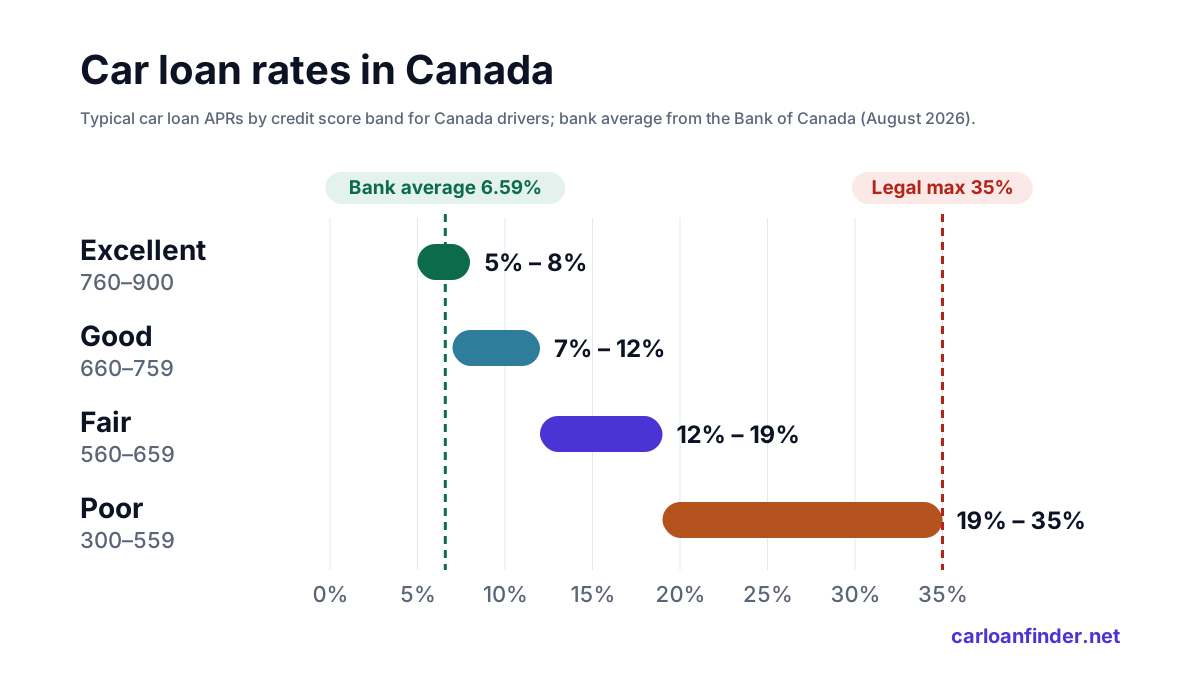
A co-signer adds a second income and a second credit history to the application. If their file is strong, the lender may approve a loan it would otherwise decline, or price it more favourably than your file alone would allow. Published estimates by Equifax score band put Fair credit (560–659) at 12%–19% and Good credit (660–759) at 7%–12%, which shows how much the credit behind a loan can matter.
The commitment is serious. A co-signer is fully responsible for the debt if you miss payments, and the loan usually appears on their credit report, where it affects their own borrowing. A late payment hurts both of you. Ask only someone who understands that, and set up automatic payments so the loan never becomes a strain on the relationship.
A co-borrower is different: they share ownership of the vehicle as well as the debt, which can make sense for a spouse or partner who will also drive the car. Agree in advance on who keeps the car, and the payments, if your circumstances change. Either way, ask how each person could be removed from the loan later, for example by refinancing in your own name once your credit has recovered.
Choosing the right combination
Each tool fixes a different weakness. If the problem is the size of the payment compared with your income, cash down or a less expensive car helps most. If the file is thin or recent problems weigh on it, a co-signer adds what the lender cannot see in your own history. A trade-in helps only when it carries equity. Combining two of them can make a borderline file workable.
Before you commit savings or ask a family member to sign, see where you stand. Car Loan Finder is not a lender; it checks your options with a soft inquiry that does not affect your credit score. Knowing which lenders may consider your profile on its own tells you how much extra support you actually need, and keeps you from asking for more than the deal requires.
Where you live affects how far each of these goes. Sales tax is GST or HST alone in some provinces and GST plus a provincial sales tax in others, and the tax on the purchase is often financed, so cash down offsets part of it. Ask the dealer how a trade-in changes the taxable amount in your province before you compare offers. Insurance comes from a public insurer in a few provinces and from private insurers elsewhere. In Quebec, also budget for winter tires, required from December 1 to March 15.
Questions about this topic
How much down payment do I need for a bad-credit car loan?
There is no fixed amount: some lenders set a minimum as a condition of approval, while others approve with little or nothing down. Any amount you can save lowers the loan, the payment and the interest you pay.
Can I trade in a car I still owe money on?
Yes, the dealer pays off the old loan as part of the deal. If you owe more than the car is worth, the difference is usually added to the new loan, which raises its cost.
Does co-signing a car loan affect the co-signer's credit?
Usually it does, because the loan appears on their credit report and counts as their debt when they apply for credit. Any late payment on the loan can lower both scores.
What is the difference between a co-signer and a co-borrower?
A co-signer backs the loan and is responsible if you do not pay, but usually does not own the vehicle. A co-borrower shares both the debt and the ownership.
Can a co-signer get me a lower interest rate on a car loan?
It can, if the co-signer's income and credit are strong enough to reduce the lender's risk. The final rate still depends on the whole application, so compare offers with and without a co-signer.
Should I save a bigger down payment or apply now?
If your current payments already take a large share of your income, waiting to save more can lead to a smaller, cheaper loan. If you need a car now, compare offers on total cost and plan to refinance once your credit improves.