What no money down really means
A true zero-down loan finances the entire purchase: vehicle price, sales tax, licensing and dealer fees. Nothing is paid on signing day, and the first payment is usually due about a month later. Lenders who offer this are betting on your income and payment history rather than your savings, so they look closely at job stability and how much of your pay already goes to debts.
Not every offer advertised this way works like that. Some dealers present a deal as no money down while splitting the down payment into a few extra instalments in the first months, on top of the regular loan payment. That can strain your budget right when you are adjusting to a new expense. Ask for the payment schedule in writing and check whether the first months cost more than the rest.
The costs of skipping the down payment
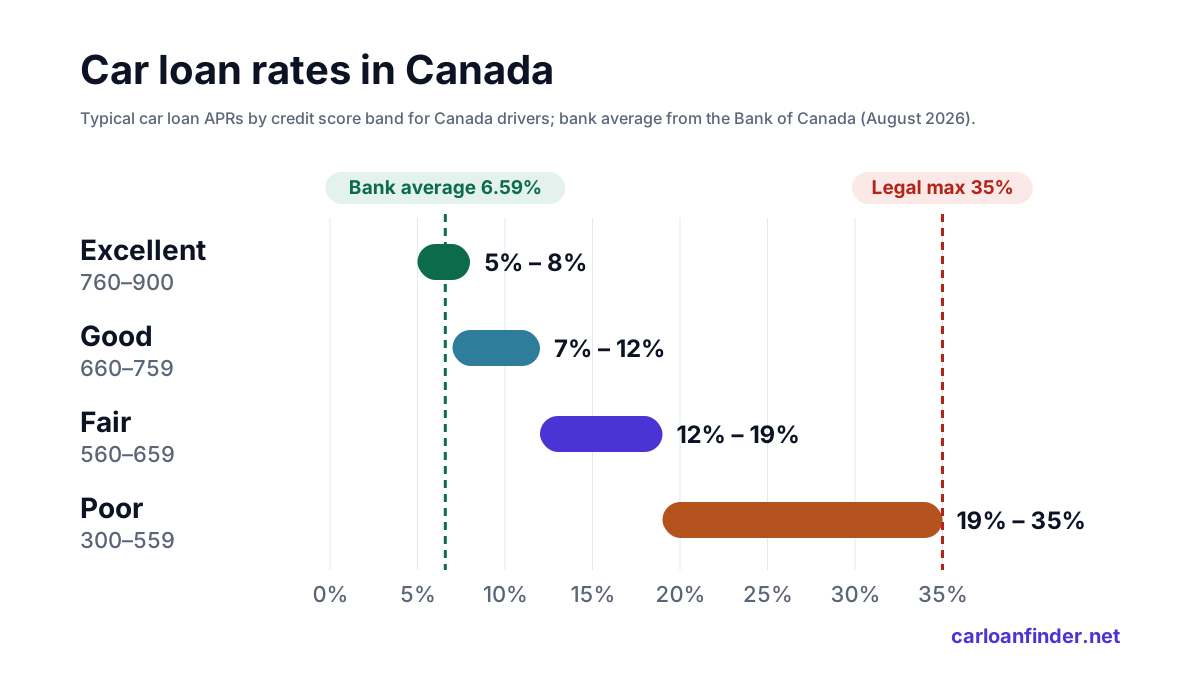
The most obvious cost is interest. A larger financed amount means more interest every month, and at the rates many borrowers with fair or poor credit face, the difference adds up quickly. Published Equifax-band estimates put fair scores (560–659) at about 12%–19% and poor scores (300–559) at 19%–35%, well above the 6.59% chartered banks averaged on new auto loans in August 2026.
The less obvious cost is negative equity. A car loses value fastest in its first years, and without a down payment the balance can stay above the car's worth for a long stretch. If the car is written off or you need to sell, you may owe the difference. Gap coverage can protect against a write-off, but it is an extra product with its own price, so compare it before accepting the dealer's version.
When zero down can make sense
There are situations where it is reasonable. If you need a car to get to work and have no savings, a modest, reliable vehicle financed with nothing down may cost less than losing income. It can also make sense when you have savings but want to keep them as an emergency fund, provided your credit earns a rate close to bank averages and the term is not stretched.
It makes less sense for an expensive vehicle, a very long term or a rate near the top of the legal range. The Criminal Code caps rates at 35% APR since January 1, 2025, but a loan below that cap can still cost far more than the car is worth to you. If the numbers only work at the longest term, consider a cheaper car first.
Steps to take if you go ahead
Check your credit report and score first, so you know which band you are in before a dealer tells you. Then get an idea of who may lend to you: Car Loan Finder is not a lender, but it matches drivers with lenders and dealers through a soft inquiry that does not affect your credit score. Choose a vehicle priced well within your budget, since everything you pick will be financed.
Keep the term as short as your payment allows and ask for the full schedule, including any split down payment instalments. Decline add-ons you do not need, because each one increases a balance that already starts at full price. Finally, plan to pay a little extra when you can. Most lenders report on-time payments to the credit bureaus, which can support refinancing later.
Financing everything means financing the tax too, and that amount depends on your province: some charge only the federal GST on a vehicle, some a harmonized HST, and others GST plus a provincial sales tax. With no down payment, the full taxed price goes into the loan. Insurance is another variable, provided by a public insurer in a few provinces and private companies in the rest, and lenders require it from day one. In Quebec, winter tires are mandatory from December 1 to March 15, a cost that cannot be rolled into the loan in every case.
Questions about this topic
Can I get a car loan with no money down and bad credit?
Some lenders do approve zero-down loans for borrowers with poor credit, usually at higher rates. Stable income and a modest vehicle price improve your chances, but approval is never certain.
What is a split down payment deal?
It is an arrangement where the dealer spreads a down payment over a few extra instalments early in the loan instead of collecting it up front. Your first months cost more than the regular payment, so ask for the full schedule in writing.
Is it a bad idea to put nothing down on a car?
Not always, but it raises total interest and the risk of owing more than the car is worth. It works best with a modest vehicle, a reasonable rate and a term that is not stretched.
Do I need gap insurance with a zero-down car loan?
It is worth considering, because without a down payment your loan balance can exceed the car's value for a long time. Compare prices from more than one provider before buying it through the dealer.
Will a down payment lower my interest rate?
It can, because the lender has less at risk relative to the car's value. Even if the rate stays the same, a down payment reduces the amount financed and the interest you pay.
Can I use my trade-in instead of a cash down payment?
Yes. Equity in a trade-in works like a down payment and reduces the amount financed. If you owe more than the trade-in is worth, that shortfall is usually added to the new loan instead.