What to put in each field
The price field should hold the amount you will actually finance. Start with the negotiated vehicle price, add sales tax and any dealer fees you cannot avoid, then subtract your down payment and the trade-in value. If you still owe money on your trade, subtract only the equity, or add the shortfall if you owe more than it is worth. Getting this figure right matters more than any other input.
Next come the term and the payment frequency. Terms are usually quoted in months, and many lenders offer weekly or biweekly payments as well as monthly ones. Paying more often does not change the rate, but it can trim interest slightly because the balance falls sooner. If the calculator asks for an amortization period separately from the term, keep them the same unless a lender has told you otherwise.
Picking a rate that fits your credit
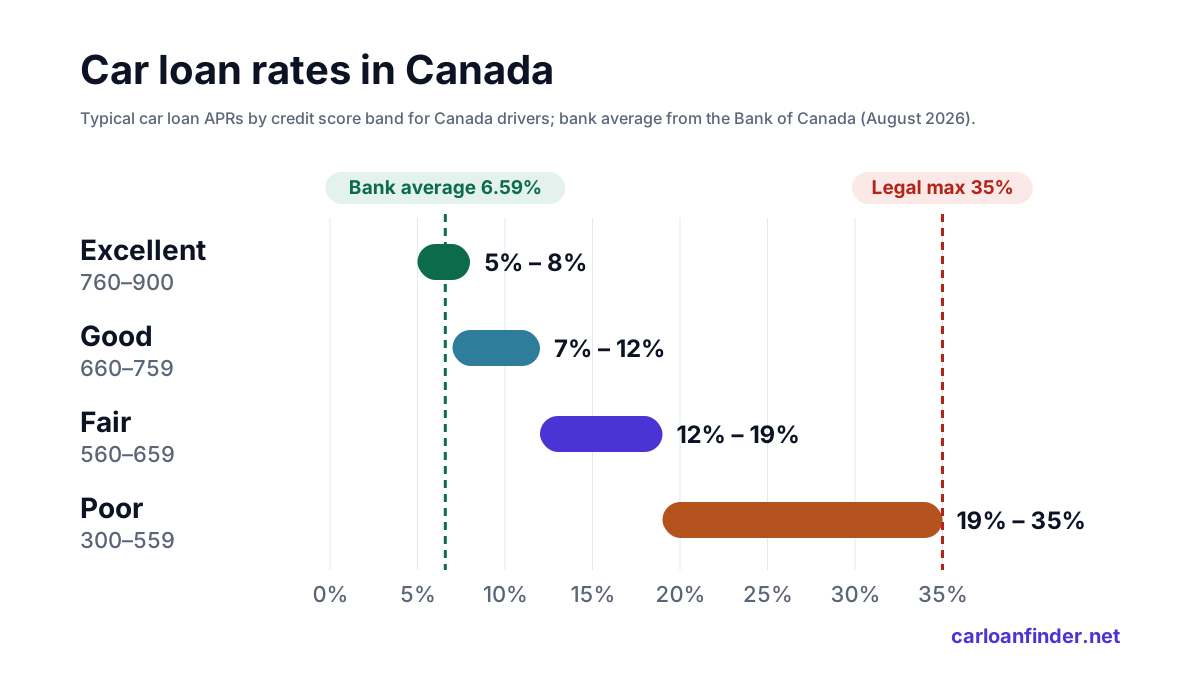
Many calculators fill in a default rate that suits only borrowers with strong credit. The Bank of Canada reported an average of 6.59% on new auto loans at chartered banks in August 2026, and 6.83% on existing ones. Those averages are a fair assumption if your score is excellent and you plan to borrow from a bank, but they can badly understate the payment for anyone else.
Published estimates by Equifax score band give a more honest starting point: about 5%–8% for excellent scores (760–900), 7%–12% for good (660–759), 12%–19% for fair (560–659) and 19%–35% for poor (300–559). Run your numbers at the top of your band, not the bottom. If the payment still fits your budget at the higher rate, you have a cushion when the real offer arrives.
Running scenarios before you shop
Once the basics are in, change one input at a time. Compare 60, 72 and 84 months with everything else fixed and note the total interest each produces, not just the payment. The longest term almost always shows the smallest payment and the largest total cost. Seeing that difference in your own numbers makes it easier to resist a dealer who offers to stretch the loan to hit a target payment.
Try the down payment field the same way. A larger down payment lowers both the amount financed and, with some lenders, the rate they are willing to offer, because the loan is smaller relative to the car's value. You can also work backwards: set the payment you can afford, choose your rate band and term, and see what vehicle price that supports.
What a payment estimate leaves out
A loan calculator covers principal and interest only. It does not include insurance, fuel, maintenance, licence and registration, parking or repairs, and those costs can rival the loan payment itself on an older vehicle. Add them up separately and make sure the total, not just the loan, fits your monthly budget with room to spare for surprises.
It also cannot tell you whether you will be approved or at what rate. That depends on your credit file, income and the vehicle. Car Loan Finder is not a lender; it uses a soft inquiry that does not affect your credit score to match you with lenders and dealers, so you can replace your assumed rate with real offers and compare them on equal terms.
Province matters most in the price field. Some provinces charge only the federal GST on a vehicle, others a harmonized HST, and others GST plus a separate provincial sales tax, so the taxed price you finance is not the same everywhere. A few provinces sell auto insurance through a public insurer while the rest use private companies, which changes the monthly cost of owning the car even though it never appears in the loan. In Quebec, winter tires are mandatory from December 1 to March 15, so a set may belong in your budget.
Questions about this topic
How accurate is a car loan calculator?
The arithmetic is exact, but the result depends entirely on what you enter. With the right financed amount and a realistic rate for your credit band, it gives a close estimate of the payment.
What interest rate should I enter if I have bad credit?
Published Equifax-band estimates put poor scores (300–559) at 19%–35% and fair scores (560–659) at 12%–19%. Use the upper end of your band to avoid underestimating the payment.
Should I include sales tax in the calculator?
Yes, if you plan to finance it, which most buyers do. Sales tax differs by province, so use the rate that applies where you will register the vehicle.
Do biweekly payments save money compared with monthly ones?
They can save a little interest because the balance drops sooner. The rate is usually the same, so the saving is modest, but it adds up over a long term.
Why is my dealer's payment higher than the calculator showed?
The dealer's figure may include fees, add-on products or a different rate or term. Ask for an itemized breakdown and enter those exact figures to see where the difference comes from.
Does using a car loan calculator affect my credit score?
No. A calculator does not check your credit at all. Even Car Loan Finder's matching step uses a soft inquiry that does not affect your credit score.