What the dealer finance office does with your application
At a dealership, the finance office, often called F&I for finance and insurance, is the bridge between you and the lenders. You fill in one credit application; the finance manager reviews it, pulls your credit with your consent and decides which lenders are likely to consider a file like yours. Banks, the car makers' own finance companies and subprime lenders each have different rules.
The finance office then submits the file, sometimes to several lenders, and reads back the responses: approved, declined, or approved with conditions such as a larger down payment, a shorter term or a different vehicle. This is why the car you picked can change during the process. The finance manager is matching your file to a lender's rules, not only selling the car on the lot.
Keep in mind that the finance office works for the dealership, which can also be compensated by the lender and earns money on the add-on products sold with the loan. Ask whether the rate quoted is the rate the lender approved, and treat extended service contracts, payment protection and similar extras as separate decisions you are free to decline.
What a subprime lender reads in your credit file
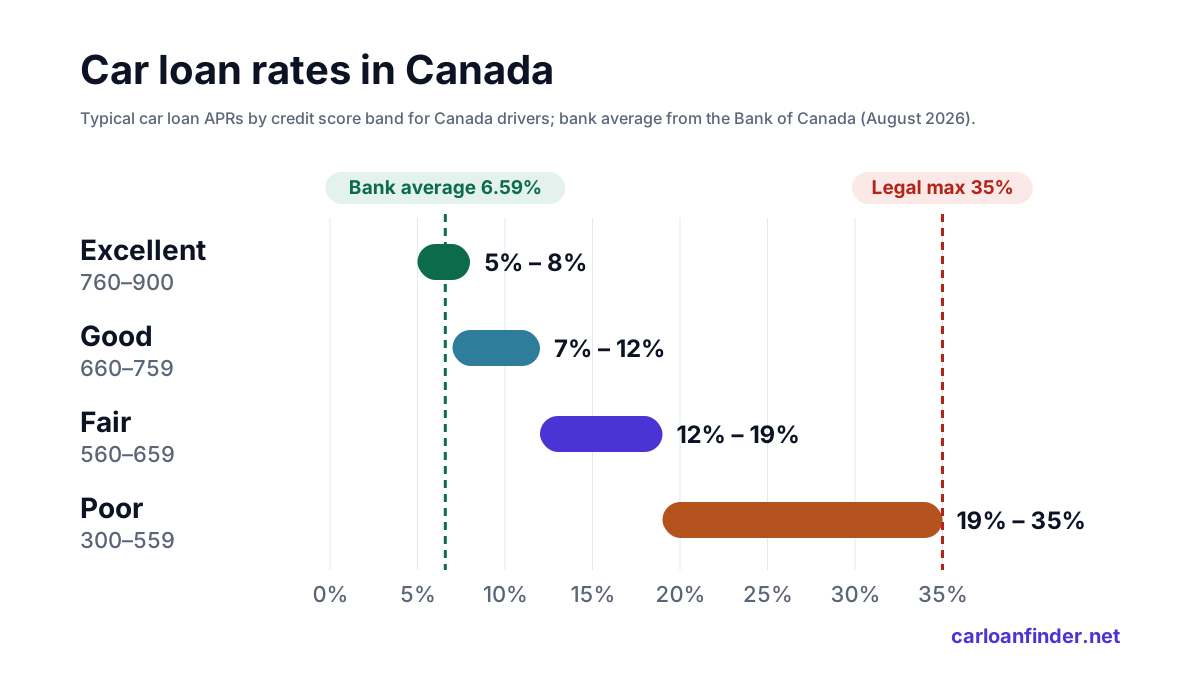
Subprime lenders specialise in files that banks turn down, so a low score does not end the review the way it might at a bank. Scores run from 300 to 900, and published estimates by Equifax score band place the Fair band (560–659) at 12%–19% and the Poor band (300–559) at 19%–35%. Your band mostly sets the price; the rest of the file decides whether there is a loan at all.
The underwriter reads the report for patterns rather than a single number. Are the late payments old or recent? Has a past bankruptcy or consumer proposal been discharged, and have new accounts stayed in good standing since? Are collections still open? A file showing a bad stretch followed by a clean recent history often reads better than a middling score with fresh problems.
Lenders also note how many recent hard inquiries appear, how much of your available credit you are using and how long your accounts have been open. A thin file is not a bad file, but it gives the underwriter less to go on, which is why newer borrowers are sometimes asked for a co-signer or a larger down payment.
Income, stability and the payment you can carry
Ability to pay is the heart of a subprime decision. The lender wants income it can verify: recent pay stubs and sometimes an employment letter for salaried workers, notices of assessment and bank statements for the self-employed, and benefit statements for pension or other regular income. Income that cannot be documented often counts for little in the final decision.
Next comes the ratio of payments to income. The lender adds the proposed car payment to your existing obligations, such as rent or mortgage, card minimums and other loans, and compares the total with your monthly income. Each lender sets its own ceiling. If the new loan would take you over it, the usual answer is a smaller loan, a longer term or a request for more money down.
Stability fills in the picture. Time at your current job and address, a working phone number and references the lender can reach all suggest you will be there to make the payments. None of these replaces income, but a borrower with a few years at the same employer often gets more room than one who changed jobs last month.
The vehicle is part of the application
Because the car secures the loan, the lender assesses it too. It compares the amount you want to borrow with the vehicle's value, and a loan well above that value, because of taxes, add-ons or negative equity carried over from a trade-in, raises the risk. Many subprime lenders also limit the age and mileage of the vehicles they finance and the term they offer on older cars.
That is why a down payment or a less expensive vehicle can turn a decline into an approval. Before you visit a dealer, Car Loan Finder can check your options with a soft inquiry that does not affect your credit score; it is not a lender, but it shows which lenders may consider a profile like yours. Then compare every approval on APR, term and total cost, and ask for each offer in writing before you sign anything at the dealership.
Underwriting works much the same way across Canada, but the figures a lender works with vary by province. The amount financed often includes sales tax, which is GST or HST alone in some provinces and GST plus a provincial sales tax in others. Insurance costs differ between provinces with a public insurer and those served by private insurers, and lenders usually ask for proof of coverage before funding. In Quebec, winter tires are mandatory from December 1 to March 15, a cost some buyers roll into the financing.
Questions about this topic
Do subprime lenders look at more than my credit score?
Yes. They weigh verified income, the share of that income already going to other payments, job and address stability, recent payment history and the vehicle itself.
Why did the dealer send my application to several lenders?
Each lender has its own rules for score, income and vehicle, so the finance office sends the file where it is most likely to fit. Ask how many lenders will see your file and whether each one will pull your credit.
What does approved with conditions mean on a car loan?
It means the lender will fund the loan if something changes, such as a larger down payment, a shorter term, a co-signer or a less expensive vehicle. It may also require documents, like proof of income or address, before the money is released.
What documents do subprime auto lenders ask for?
Expect government photo ID and your driver's licence, recent pay stubs or notices of assessment, proof of address and sometimes bank statements. Having them ready shortens the review and keeps a conditional approval from stalling.
Can the dealer's rate differ from the rate the lender approved?
It can, because dealers may be compensated by the lender and the rate offered to you can reflect that. Ask whether the quoted rate is the lender's approved rate and compare it with offers you obtained elsewhere.
What interest rate do subprime car lenders charge?
Rates depend on the whole file, but published estimates by Equifax score band run from 12%–19% for Fair credit (560–659) to 19%–35% for Poor credit (300–559). No lender may charge more than 35% APR, the Criminal Code cap since January 1, 2025.