Tip 1: Budget for the car, not just the loan
Start with what you can spend each month on the whole vehicle: loan payment, insurance, fuel, maintenance and registration. Subtract the running costs from that total and the remainder is the loan payment you can carry. Working from this number keeps you from falling for a car that fits the loan but strains everything else.
Then decide how much you can put down. A down payment or trade-in shrinks the amount financed, which lowers the payment and the total interest. It also helps lenders see the loan as lower risk, which matters most if your credit is fair or poor. Even a modest amount set aside now can make the difference between two offers.
Tip 2: Check your credit before a lender does
Canadian credit scores run from 300 to 900, and lenders price loans by where you fall in that range. Get your credit report from the bureaus and look for errors such as accounts that are not yours or payments wrongly marked late. Disputing mistakes before you apply can change the offers you receive.
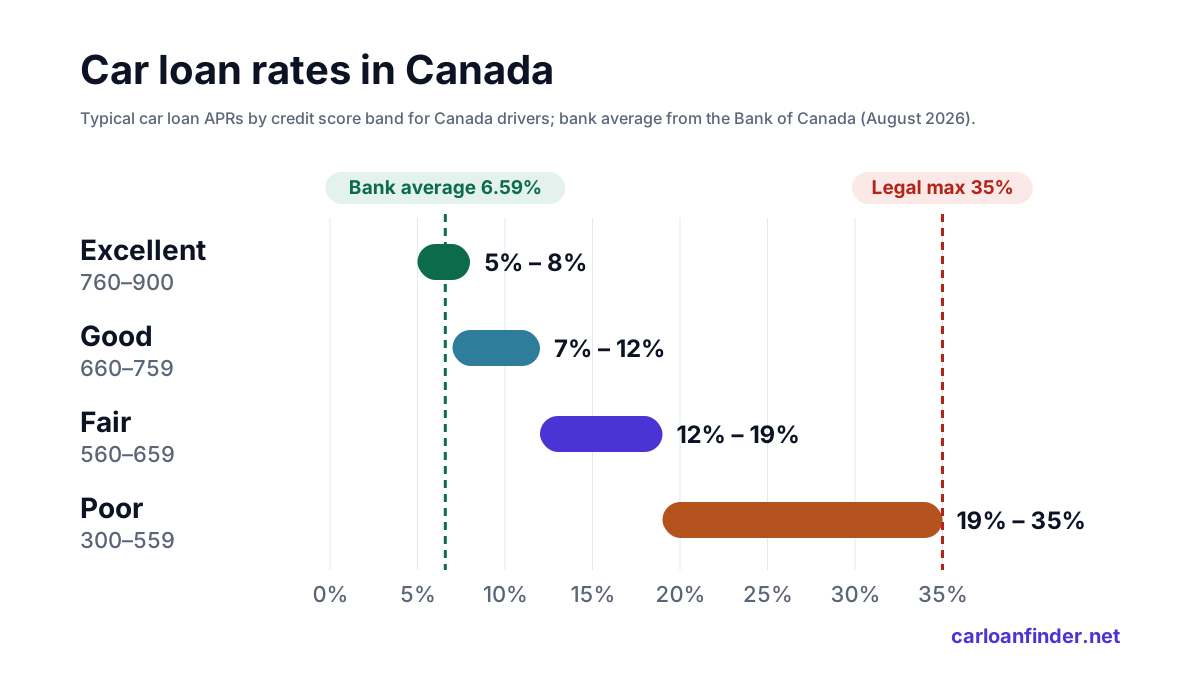
Knowing your score also tells you what to expect. Published estimates by Equifax band put good scores (660–759) at about 7%–12% and fair scores (560–659) at 12%–19%. If an offer lands far outside your band, you will know to ask questions. If your score is low, consider whether a few months of on-time payments first would put you in a better position.
Tip 3: Choose where the money comes from
Banks, credit unions, dealer financing and specialized lenders for bad credit each suit different borrowers. Banks averaged 6.59% on new auto loans in August 2026 but approve mostly strong files. Dealers can send one application to several lenders, which is convenient, though they may earn a share of the rate. Specialized lenders accept more risk and charge for it.
Having one option arranged before you visit the dealer gives you a figure to beat. Car Loan Finder is not a lender; it matches you with lenders and dealers through a soft inquiry that does not affect your credit score, so you can see where you stand before any formal application.
Tip 4: Pick the car, then negotiate in two steps
Choose a vehicle that fits the budget from Tip 1, keeping in mind that lenders often treat newer, lower-mileage cars as better security. A reliable used car can keep the loan small without the repair risk of a very old one. Have a mechanic inspect any used vehicle before you agree to buy.
Settle the price before discussing financing or monthly payments. When price, trade-in and loan are mixed together, it becomes hard to see where you are paying more. Once the price is written down, ask the dealer whether its financing can improve on the option you already have. If it can, compare both offers on the same term before deciding.
Tip 5: Prepare the paperwork and read it
Bring proof of identity, recent pay stubs or other proof of income, proof of address, and your driver's licence. Self-employed buyers may need tax returns or bank statements instead. Arriving prepared speeds up approval and lets you focus on the contract rather than chasing documents. Keep copies of everything you hand over, along with the signed contract, in one place.
Before signing, check that the price, down payment, amount financed, APR and term match what you agreed. Remove any add-on you did not ask for. No legal lender in Canada can exceed 35% APR, the criminal rate since January 1, 2025, but a legal rate can still be too high for your budget.
A few costs that shape the loan depend on your province. Sales tax on vehicles ranges from the federal GST alone to a harmonized HST to GST plus a provincial tax, and most buyers finance that tax along with the car. Auto insurance comes from a public insurer in a few provinces and private companies elsewhere, so get a quote before you commit to a payment. Quebec drivers also need winter tires from December 1 to March 15, an expense to plan for if the car you choose does not come with a set.
Questions about this topic
Is it better to finance a car through a bank or a dealer?
It depends on your credit. Banks tend to offer lower rates to strong borrowers, while dealers can reach several lenders at once, so getting an outside option first lets you compare.
What documents do I need to finance a car in Canada?
Most lenders ask for identification, proof of income, proof of address and a driver's licence. Self-employed buyers are often asked for tax returns or bank statements.
Can I finance a car with fair or poor credit?
Often yes, though at a higher rate. Published Equifax-band estimates run from 12%–19% for fair scores and 19%–35% for poor scores, and a down payment can improve your chances.
Should I tell the dealer I already have financing?
Negotiate the vehicle price first, then mention your financing option. That keeps the price talk separate and gives the dealer a clear figure to beat.
How much should I put down on a car?
There is no fixed rule, but any down payment lowers the amount financed and the total interest. It also reduces the risk of owing more than the car is worth early in the loan.
What credit score do I need to finance a car?
There is no single cut-off, since lenders set their own criteria on a 300 to 900 scale. Higher scores generally qualify for lower rates, and some lenders specialize in lower scores.