How car loan refinancing works
A new lender, or sometimes your current one, issues a loan that pays off your existing balance. You then make payments on the new loan, at its rate and over its term. The car remains the security for the debt, so the new lender will look at its age, mileage and value as well as at your credit, income and payment history on the current loan.
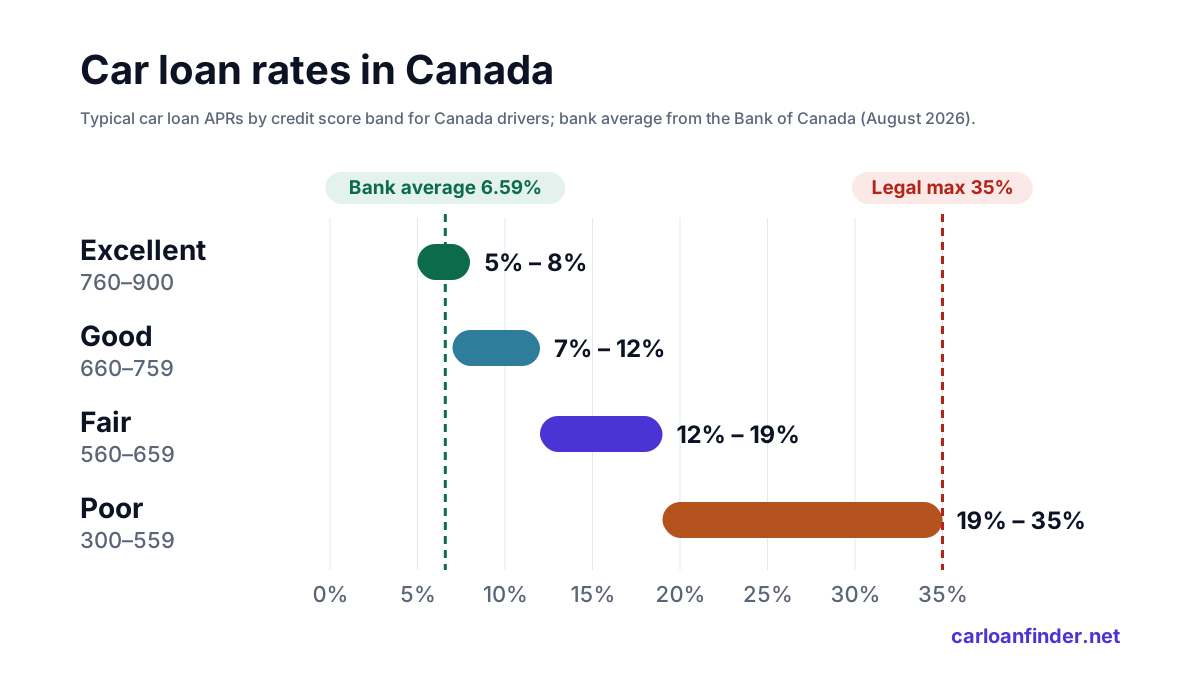
Rates on existing loans can differ from rates on new ones. The Bank of Canada reported an average of 6.83% on existing auto loans at chartered banks in August 2026, compared with 6.59% on new auto loans. Those averages describe bank borrowers; if your current loan came from a subprime lender at a much higher rate, the gap you could close may be far wider.
Before anything else, ask your current lender for a payout statement. It shows exactly how much it takes to close the loan on a given date, including any interest owing and any charge for paying early. That figure, not the balance on your last statement, is what a new loan has to cover.
The advantages
The biggest gain comes from a better credit tier. Published estimates by Equifax score band put poor credit (300–559) at 19%–35%, fair credit (560–659) at 12%–19% and good credit (660–759) at 7%–12%. If a year of on-time payments has lifted you from one band into the next, the rate you qualify for today may be well below the one you signed for.
Refinancing can also reshape the loan to suit your life now. You can shorten the term to pay the car off sooner and save interest, or lower the payment if your budget has tightened. Some borrowers refinance to remove a co-signer from the loan once their own credit can carry it, which frees that person from the obligation.
Finally, a refinance is a chance to fix a contract you regret. If add-ons were bundled into the original loan, or the rate was set before you had a chance to compare, a new loan with clearer terms can reset the deal. Read the new contract as carefully as you wish you had read the first one.
The disadvantages
A lower payment is not always a cheaper loan. If you stretch the remaining balance over a longer term, you can end up paying more interest overall even at a lower rate. You also stay in debt longer on a car that is aging, which raises the odds that repairs and payments overlap in the final years of the loan.
Cash-out refinancing carries the most risk. Borrowing against your car to free up money increases the balance on an asset that loses value, and it can leave you owing more than the car is worth. If you need to sell or trade it, that shortfall follows you. Treat it as a last resort, not as a convenient way to cover other bills.
There are smaller costs too. Your current loan may carry a prepayment charge, a new lender may charge fees, and a formal application leads to a hard inquiry on your credit file. Lenders may also decline to refinance older or high-mileage vehicles. Add these up before deciding whether the savings are real.
Running the numbers before you apply
Compare total remaining cost, not payments. Add up what you will still pay on the current loan from today to the end of its term. Then add up what you would pay on the new loan, plus any fees and prepayment charges. If the second number is lower, and the term is no longer than you are comfortable with, refinancing is worth a closer look.
Check every offer against the legal ceiling as well: since January 1, 2025, the Criminal Code has capped interest at 35% APR. An offer near that level is rarely an improvement for someone who already has a loan in good standing. Most lenders report on-time payments to the credit bureaus, so your history on the current loan is your strongest argument.
To see whether a better rate is realistic without adding hard inquiries, start with a soft check. Car Loan Finder is not a lender; it checks options with a soft inquiry that does not affect your credit score. If the options it shows do not beat your current loan on total cost, keeping the loan you have is a perfectly good decision.
Refinancing changes your loan, not your purchase. The sales tax was charged when you bought the car, at your province's GST and provincial rate or its HST as listed by the Canada Revenue Agency, and it is already part of the balance you carry. Insurance stays in place as well: whether your province has a public insurer or private companies, a new lender will ask for proof of coverage. In Quebec, if you are taking cash out, remember the winter tire season from December 1 to March 15 before spending it elsewhere.
Questions about this topic
When does it make sense to refinance a car loan?
It usually makes sense when your credit has improved or rates have dropped enough to cut the total cost of what you still owe, after fees. It rarely makes sense if the main effect is a longer term.
Will refinancing hurt my credit score?
A formal application creates a hard inquiry, which can lower your score slightly for a while. Checking options first with a soft inquiry, as Car Loan Finder does, does not affect your credit score.
Can I refinance my car loan with bad credit?
It is possible, but the new rate may not beat your current one. Published estimates by Equifax score band put poor credit (300–559) at about 19%–35%, so compare total cost carefully.
Is there a penalty for paying off a car loan early?
Some loan contracts include a prepayment charge and others do not. Ask your lender for a payout statement, which shows the full amount needed to close the loan on a specific date.
Can I take cash out when I refinance my car?
Some lenders allow it, but it increases what you owe on a vehicle that keeps losing value. It can leave you owing more than the car is worth, so use it with caution.
Can I remove a co-signer by refinancing?
Yes, if your own credit and income are strong enough for a lender to approve the loan in your name alone. The new loan pays off the old one, which releases the co-signer from it.