How lenders decide what rate to offer
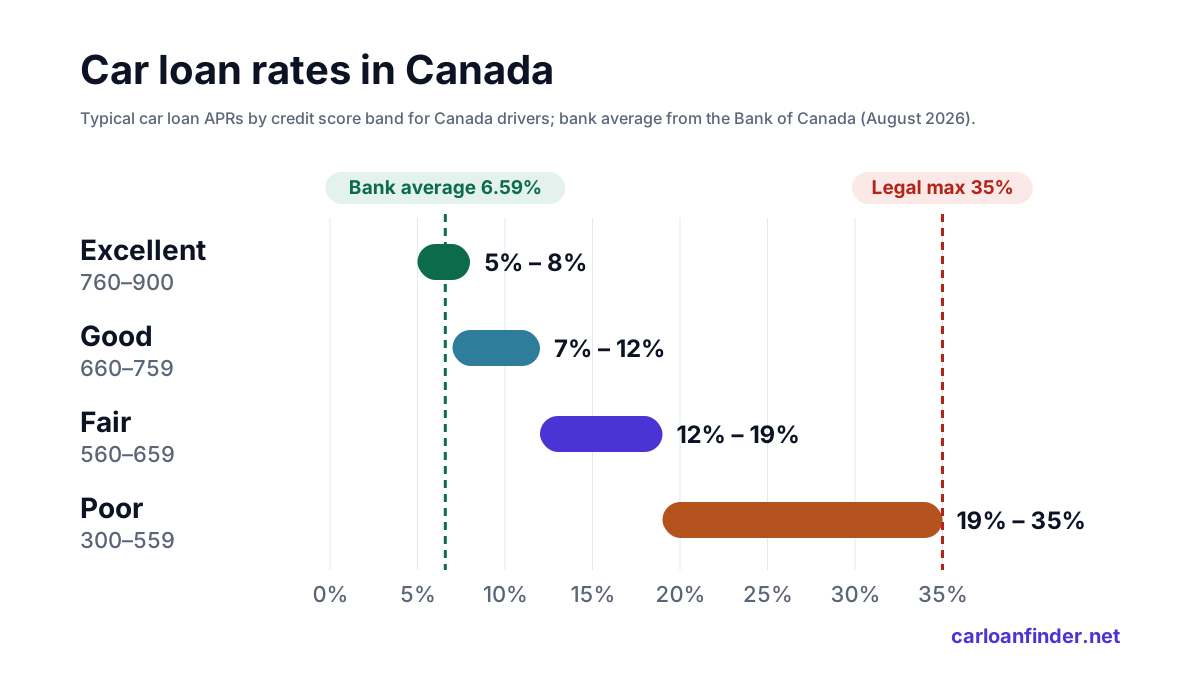
Your credit score, on a scale of 300 to 900, is the starting point. Published Equifax-band estimates show how much it matters: about 5%–8% for excellent scores (760–900), 7%–12% for good (660–759), 12%–19% for fair (560–659) and 19%–35% for poor (300–559). Moving up a single band can change the cost of a loan more than any amount of haggling at the dealership.
Lenders also look at how much of your income already goes to debt payments, how stable your job and address are, and how the loan compares with the car's value. A loan close to or above the vehicle's worth is riskier, so it is priced higher. Older, high-mileage vehicles are harder to resell if a loan goes bad, which is why they often attract higher rates too.
Strengthen your credit file before you apply
Get your credit report from the bureaus at least a few weeks before shopping. Look for accounts you do not recognize, old debts still shown as unpaid, or late payments that were actually on time. Disputes take time to resolve, so starting early gives corrections a chance to appear before a lender pulls your file.
Next, look at your credit card balances. Using a large share of your available limits weighs on your score, and paying balances down is one of the quicker ways to improve it. Avoid opening new credit accounts in the months before a car loan application, and keep every existing payment on time, since payment history carries the most weight in a score.
Shape the loan so it looks safer
A down payment or trade-in equity reduces the amount financed and gives the lender a cushion against the car's depreciation. Even when it does not change the quoted rate, it cuts the total interest. Choosing a shorter term works in a similar way: lenders often price shorter loans more favourably, and you pay interest for fewer months.
If your credit is thin or damaged, a co-signer with stronger credit can lower the risk a lender sees. Make sure the co-signer understands that they are fully responsible if you miss payments, and that the loan appears on their credit report as well. Picking a newer, lower-mileage vehicle within your budget can also help the loan qualify for a lower rate tier.
Know when an offer matches your profile
Once offers arrive, measure them against what your profile supports. Chartered banks averaged 6.59% on new auto loans in August 2026, a reasonable reference only for excellent credit. If your score sits in the fair band and an offer falls within 12%–19%, it is in line with published estimates; well above that, ask the lender which factor drove the price.
Car Loan Finder is not a lender, but its soft inquiry, which does not affect your credit score, lets you see which lenders may work with your file before formal applications. If the rate you accept is high, it does not have to be permanent: most lenders report on-time payments to the credit bureaus, and a stronger score later can support refinancing.
The rate a lender offers does not depend on your province, but the amount you borrow can. Sales tax on vehicles differs across Canada, from GST alone to HST to GST plus a provincial tax, and a larger financed amount can shift how a lender views the loan. Insurance is sold by a public insurer in a few provinces and by private companies elsewhere; lenders require coverage, so price it early. In Quebec, the winter tire requirement runs from December 1 to March 15. The 35% APR criminal rate cap applies in every province.
Questions about this topic
How do I know if my car loan rate is fair?
Compare it with the published Equifax-band estimate for your score. If it falls inside your band and the fees are clear, it is in line with your profile; if it is well above, ask the lender why.
How fast can I improve my credit score before buying a car?
Paying down card balances and correcting report errors can show results within a few billing cycles. Building a longer record of on-time payments takes more time but has the largest effect.
Does a bigger down payment lower my car loan rate?
Sometimes, because the lender has less at risk relative to the car's value. Even when the rate stays the same, a larger down payment lowers the amount financed and the total interest.
Will a co-signer get me a lower rate?
A co-signer with stronger credit can reduce the lender's risk and may lead to a lower rate. The co-signer is fully responsible for the debt if you do not pay.
Can I lower my car loan rate after I sign?
Not on the same contract, but you may be able to refinance later. After a period of on-time payments and a higher score, another lender may offer a lower rate on the remaining balance.
Does the age of the car affect the interest rate?
It often does. Lenders tend to see newer, lower-mileage vehicles as better security, while older cars can carry higher rates or shorter maximum terms.