Terms about the price of borrowing
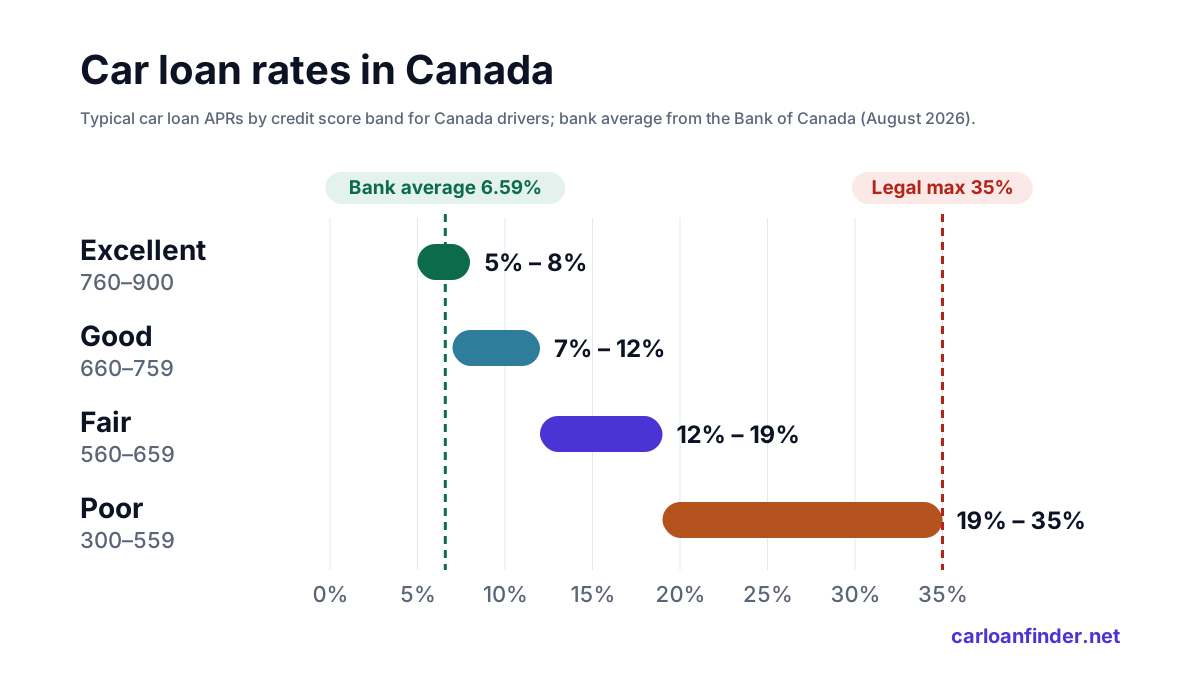
Interest rate: the yearly percentage charged on the amount you owe. APR, or annual percentage rate: the interest rate plus most lender fees, expressed as one yearly figure, which makes it the fairest way to compare offers. Since January 1, 2025, the Criminal Code caps lending at 35% APR. Cost of borrowing: the total interest and fees over the whole loan, shown as a dollar amount in your disclosure statement.
Prime rate: the rate banks use as a base for many loans, 4.45% in October 2026. Bank average: the Bank of Canada reports the average rate on new auto loans at chartered banks, 6.59% in August 2026. Subprime: a loan made to a borrower with a low score, usually priced well above that average, with published estimates of 19%–35% for the Poor band.
Terms about the shape of the loan
Principal: the amount you borrow, before interest. Down payment: cash you pay upfront, which reduces the principal. Trade-in value: what a dealer credits you for your current vehicle. Term: the number of months you take to repay. Amortization: how each payment is split between interest and principal; early payments are mostly interest, which is why paying off a loan early saves money.
Open loan: a loan you can repay early without a penalty. Closed loan: one that charges a penalty or fee for early repayment. Bi-weekly payments: payments every two weeks instead of monthly, often timed to payday. Add-ons: optional products sold with the car, such as an extended service contract or gap insurance, which are often financed and charged interest at your loan rate.
Terms about the risks you take on
Negative equity: owing more on your car than it is worth, sometimes called being upside down. Rollover: adding the negative equity from your old loan to a new one, which raises the principal before you drive away. Depreciation: the loss in a car's value over time, the main reason negative equity happens on long loans.
Lien: the lender's legal claim on the car until the loan is paid, recorded in a provincial registry. Repossession: the lender taking back the car after missed payments, subject to provincial rules. Co-signer: a person who signs the loan with you and becomes fully responsible for it if you stop paying. Default: failing to meet the loan terms, most often by missing payments.
Terms about credit checks and approval
Credit score: a number from 300 to 900 summarising your credit history. Equifax groups scores into bands such as Fair (560–659) and Poor (300–559). Soft inquiry: a check that lets a lender or service see your profile without affecting your score; Car Loan Finder uses one to check options. Hard inquiry: the check made when you formally apply for credit, which can lower your score slightly.
Pre-qualification: an early estimate of what you might be approved for, usually based on a soft check. Conditional approval: a lender's yes that depends on conditions such as proof of income or a minimum down payment. Stipulations: the specific documents or conditions a lender requires before funding. Funding: the moment the lender pays the dealer and your loan officially begins.
Most of these terms mean the same thing everywhere in Canada, but some of the rules behind them are provincial. Each province has consumer protection law requiring lenders to disclose the cost of borrowing, and each runs its own registry where a lender records its lien on your car. The sales tax added to the price also depends on your province, as does who provides basic insurance: a public insurer in some provinces, private companies in others. In Quebec, winter tires are required from Dec 1 to Mar 15.
Questions about this topic
What is the difference between the interest rate and the APR?
The interest rate is the yearly charge on what you owe, while the APR adds most lender fees to give one comparable figure. When comparing car loan offers, always compare APRs.
What does negative equity mean on a car loan?
It means you owe more on the car than it is currently worth. If you trade the car in, the shortfall is often added to your next loan, so you start that loan already behind.
What is a soft credit check?
A soft check lets a lender or service view your credit profile without affecting your score. Car Loan Finder uses a soft inquiry to check your options.
What does loan term mean?
The term is the length of time you have to repay, usually stated in months. A longer term lowers each payment but increases the total interest you pay.
What is a lien on a car?
A lien is the lender's legal claim on the vehicle until the loan is fully repaid. It is recorded in a provincial registry and removed once the balance is cleared.
What is subprime auto financing?
It is financing for borrowers with low credit scores, priced higher to reflect the lender's risk. Published estimates put rates for the Poor band at 19%–35%, and no legal loan can exceed 35% APR.