Banks and credit unions
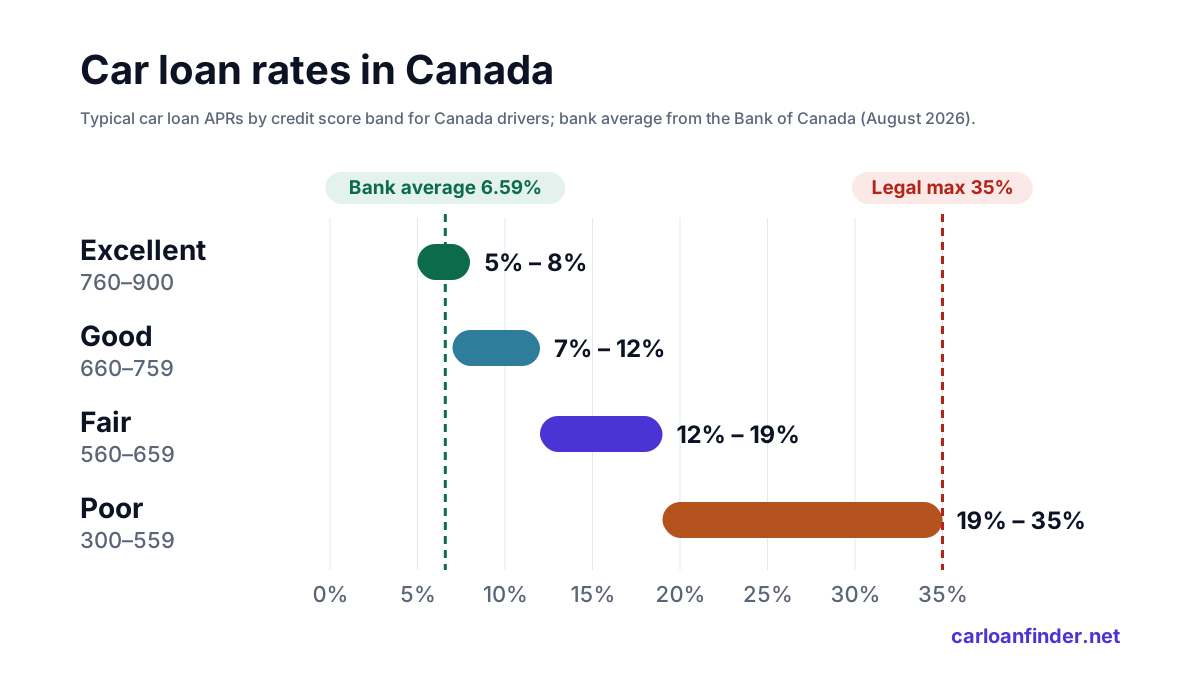
Chartered banks are the benchmark: the Bank of Canada reports their average rate on new auto loans was 6.59% in August 2026. Banks usually lend to borrowers in the Excellent and Good bands, with published estimates of 5%–8% and 7%–12%. With a score in the Fair or Poor range, a bank application is more likely to end in a decline, and each one adds a hard inquiry to your file.
Credit unions are member-owned, and many make lending decisions locally. If you already bank with one, your account history, steady deposits and length of membership can count alongside your score. They are not a sure thing with bad credit, but they are worth a conversation, especially if your credit problems are in the past and your income is stable.
Dealer financing
Most dealers arrange financing on the spot by sending your application to a group of lenders, which can include banks, manufacturers' finance companies and subprime lenders. The convenience is real: one application can produce several answers. Some dealers also offer in-house financing, where the dealership itself is the lender, often for older vehicles and with weekly or bi-weekly payments.
The trade-off is transparency. A dealer may be paid by the lender for arranging the loan, and the rate you are offered is not always the lowest one you qualified for. Ask for the APR and the total cost of borrowing in writing, decline add-ons you do not need, and compare the offer with at least one outside option before signing.
Specialty and subprime lenders
Specialty lenders focus on borrowers banks decline: low scores, recent bankruptcies or consumer proposals, new arrivals with no Canadian credit history and self-employed workers with irregular income. They look more closely at income, job stability and down payment than at the score alone, and many work through dealers rather than directly with the public.
The cost reflects the risk. Published estimates put the Fair band at 12%–19% and the Poor band at 19%–35%, and since January 1, 2025 the Criminal Code caps lending at 35% APR. A specialty loan can be a useful bridge if the payment fits your budget and the contract allows you to refinance later without a heavy penalty.
An order that saves hard inquiries
Start with what costs you nothing: pull your credit report, confirm your score band and fix any errors. Then check your options with a soft inquiry. Car Loan Finder is not a lender; it connects you with lenders and dealers and checks options with a soft inquiry, which does not affect your credit score.
Once you know which kinds of lenders are realistic, apply formally to the one or two most likely to approve you, within a short window. If you bank with a credit union, ask there first. Compare every offer on APR, term and total cost rather than the monthly payment, and walk away from any lender that pressures you to sign the same day.
Where you live affects some of these options. Credit unions are regulated provincially, so their membership rules and lending approach vary across the country; in Quebec, most are known as caisses. Car dealers are licensed by a regulator in each province, which handles complaints about a sale or the financing a dealer arranged. Whichever lender you choose, the sales tax on the vehicle depends on your province, and so does whether basic insurance comes from a public insurer. In Quebec, plan for winter tires from Dec 1 to Mar 15.
Questions about this topic
Will a bank give me a car loan with bad credit?
Some will, but banks generally favour borrowers in the Good and Excellent bands. With a Fair or Poor score, a credit union, dealer or specialty lender is often more realistic.
Are credit unions easier than banks for a car loan?
They can be, because many make decisions locally and consider your membership history. Approval still depends on your income and overall credit, so it is worth asking but not assuming.
Is dealer financing a bad idea with bad credit?
Not necessarily, since a dealer can submit your application to several lenders at once. Ask for the APR and total cost in writing and compare it with an outside offer before signing.
What is a subprime auto lender?
It is a lender that specialises in borrowers with low scores or past credit problems. Rates are higher, with published estimates of 19%–35% for the Poor band.
What is in-house financing at a car lot?
It means the dealership lends you the money directly instead of sending your application to a separate lender. Check the rate, the vehicle's condition and whether payments are reported to the credit bureaus.
Is Car Loan Finder a lender?
No. Car Loan Finder connects drivers with lenders and dealers and checks options with a soft inquiry that does not affect your credit score.