How online car loan applications work
Most online applications happen in two stages. The first is a short pre-qualification form that asks about your income, employment, housing costs and the kind of vehicle you want. It often relies on a soft inquiry, which lets a service or lender estimate what you might qualify for without affecting your credit score.
The second stage is a full application with a specific lender or dealer. This is where you provide documents such as pay stubs and ID, and where the lender usually runs a hard inquiry. A hard inquiry can lower your score slightly, so it makes sense to reach this stage only with lenders whose estimates suit you.
Some sites are lenders, while others are services that match you with lenders or dealers. Car Loan Finder is not a lender; it checks your options with a soft inquiry that does not affect your credit score and connects you with lenders and dealers. Knowing which kind of site you are on tells you who will see your information next.
Checking that a site is trustworthy
Look for clear business information: a company name, a way to reach a person, and a privacy policy that explains how your data is stored and with whom it is shared. Check that the web address is spelled correctly and that the page uses a secure connection before you enter anything.
Read the consent screen before you submit. It should say plainly whether your application goes to one lender or to several, and whether you will be contacted by phone, email or text. If a site does not say who will receive your information, treat that as a reason to stop.
Be wary of sites that promise approval before seeing your details, that ask for a fee to process your application, or that push you to decide within minutes. A legitimate service explains what happens next and lets you take your time. If you are unsure, search for the company's name separately and look for its contact details and licence information outside the site itself.
What to share and when
At the pre-qualification stage, basic details are normally enough: your name, contact information, address, income and employer. Your social insurance number is not always required to check credit, so if a form asks for it, check whether it is optional and decide whether you want to provide it. You can always ask the lender how the number will be used.
Banking details, copies of ID and void cheques usually come later, once you are working with a specific lender on a specific offer. Upload them only through the lender's secure portal or the dealer's official process, never by replying to an unexpected email or text that asks for them, and never over public Wi-Fi.
After you apply, follow-up messages are normal, but phishing attempts can imitate them. If a message asks you to confirm your password or banking details, or to click a link to claim your approval, contact the company through the website or phone number you used originally. Do not use the link or number in the message itself.
Comparing offers and signing online
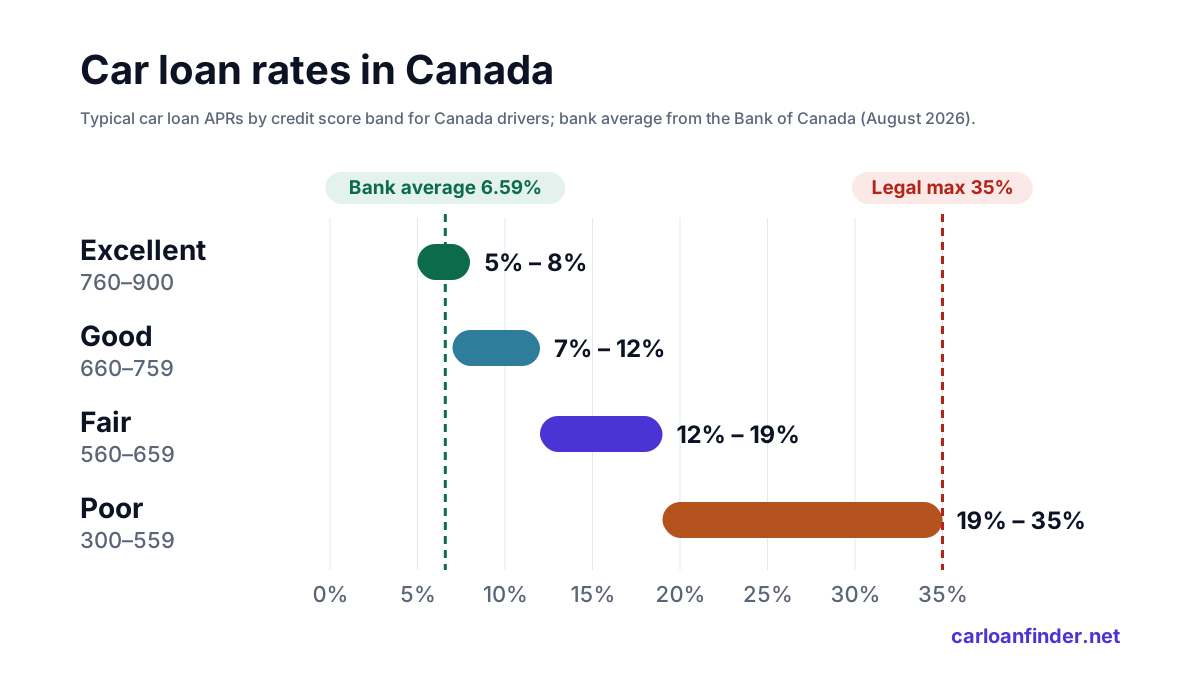
When offers come in, line them up by annual percentage rate, term and total cost of borrowing. Chartered banks averaged 6.59% on new auto loans in August 2026, according to the Bank of Canada, while Equifax estimates 12%–19% for fair credit. The rate you are offered depends on your own file.
Many contracts can now be signed electronically. An e-signature is as binding as a handwritten one, so read the full document before you click, including fees and any add-ons in the amount financed. Save a copy of the signed contract and the disclosure statement for your records, in case a question comes up later.
Check the rate against the legal limit too. Since January 1, 2025, the Criminal Code caps interest at 35% APR. An online offer near that level, or one whose terms change after you submit documents, deserves a closer look before you commit. You can decline an offer and keep comparing; applying is not an obligation to borrow.
Applying online does not change which provincial rules apply to the car you buy. Sales tax is set by province, as either HST or GST plus a provincial tax, and some provinces have specific consumer rules for contracts made at a distance or online. Insurance must still be arranged before you drive away, through a public insurer in some provinces and private companies in others. In Quebec, plan for winter tires from Dec 1 to Mar 15 if you buy in the fall.
Questions about this topic
Is it safe to apply for a car loan online?
It can be, if you confirm who runs the site, read its privacy policy and use a secure connection. Avoid sites that ask for upfront fees or will not say who receives your information.
Does an online car loan pre-approval affect my credit score?
A pre-qualification that uses a soft inquiry does not affect your score. A full application with a lender usually involves a hard inquiry, which can lower it slightly.
Do I need to give my SIN to apply for a car loan online?
Not always, since credit can often be checked without it. If a form asks for your SIN, see whether the field is optional and ask the lender why it is needed.
What documents do I need to apply for an auto loan online?
Expect to provide government photo ID, proof of income such as recent pay stubs, and proof of address. Lenders may also ask for a void cheque or bank statements later in the process.
Can I sign a car loan contract online in Canada?
Many lenders and dealers offer electronic signing. Read the full contract before signing and keep a copy, since an e-signature is binding.
How do I compare car loan offers I received online?
Compare the APR, term and total cost of borrowing rather than the monthly payment alone. Check each offer for fees and add-on products included in the amount financed.