The four credit tiers and their rate ranges
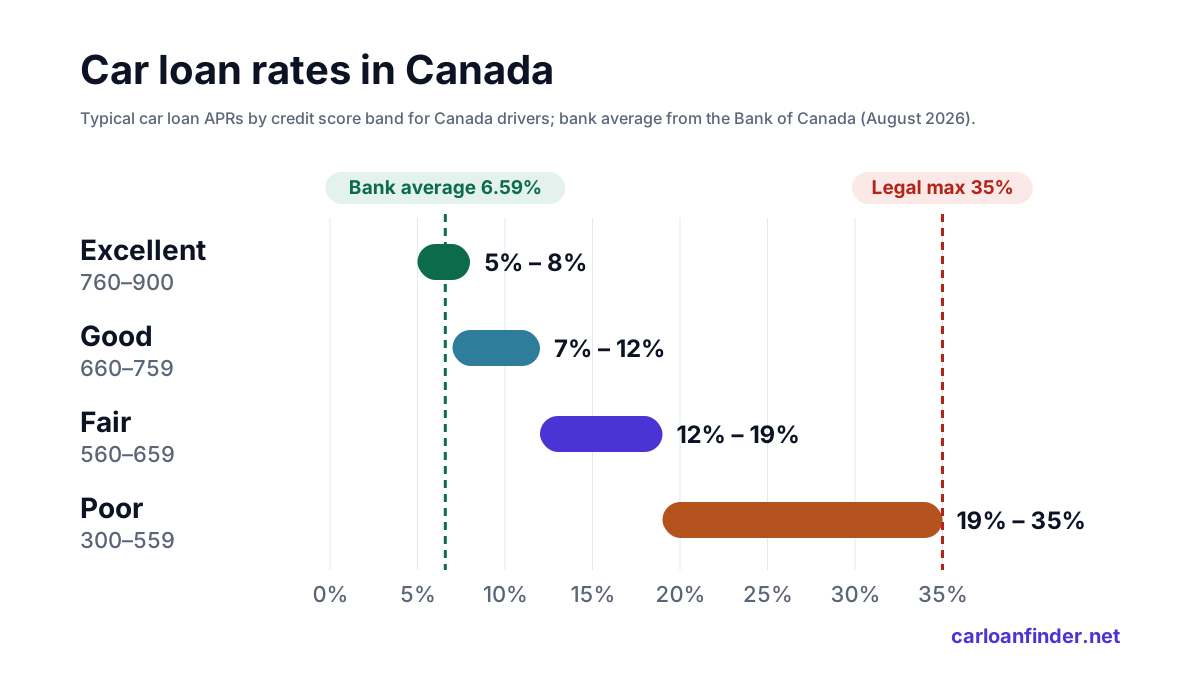
Equifax scores run from 300 to 900, and lenders group them into bands. Published estimates put car loan rates at 5%–8% for Excellent scores of 760–900, 7%–12% for Good scores of 660–759, 12%–19% for Fair scores of 560–659 and 19%–35% for Poor scores of 300–559. For reference, the Bank of Canada reports that the average rate on new auto loans at chartered banks was 6.59% in August 2026.
The ranges overlap, and your exact rate also depends on income, down payment, the car's age and the loan term. Still, the band you fall into sets the starting point. Since January 1, 2025, the Criminal Code caps lending at 35% APR, which marks the top of the Poor range and the legal ceiling for any offer.
How the tier changes your monthly payment
Take a $25,000 loan over 60 months and compare tiers. At the 6.59% bank average, the payment is about $490 a month. At a Good-tier rate of 9.50%, it is $525. At a Fair-tier rate of 15.50%, it rises to $601, and at a Poor-tier rate of 27.00%, it reaches $763, for exactly the same car.
That is why the payment, not the sticker price, is the number to test first. A car that looks affordable at a bank rate can be out of reach at a Poor rate. Work out the payment at the rate you are likely to get, then add insurance, fuel and maintenance before deciding what you can carry.
Total interest is where bad credit really bites
That monthly gap repeats for the whole loan, which is how total interest climbs. Over 60 months, a Poor-tier borrower makes 60 payments of $763 while a bank-average borrower makes 60 payments of $490, and everything paid above the $25,000 borrowed is interest. The higher the rate, the larger the share of each payment that goes to interest instead of the car, especially early on.
Longer terms lower the payment but add interest. Even at the 6.59% bank average, stretching $25,000 from 60 to 84 months adds about $1,863 in interest. In the Poor tier at 27.00%, the payment drops from $857 over 48 months to $665 over 84 months, but you pay for three more years at a high rate, so the extra interest is far larger than at a bank. A long term can make a payment fit, but it is the most expensive way to do it.
Levers that lower the cost when your score is low
Every dollar you do not borrow saves interest at your full rate, so a down payment or a trade-in with equity is worth more at bad credit rates than at good ones. Choosing a less expensive, reliable car does the same. Keep the term as short as your budget allows, and avoid rolling negative equity from an old loan into the new one.
Then plan to move up a tier. Most lenders report on-time payments to the credit bureaus, and a year or more of clean payments can lift your score enough to refinance at a lower rate. Make sure your contract allows early repayment without a heavy penalty. Comparing offers with a soft inquiry, as Car Loan Finder does, lets you see your options without affecting your score.
The rate is not the only part of the cost that changes with where you live. Sales tax on a vehicle depends on your province, and when that tax is financed along with the car, you pay interest on it too, which hits hardest at bad credit rates. Insurance is another provincial variable: some provinces have a public insurer for basic coverage, others leave it to private companies. In Quebec, winter tires are required from Dec 1 to Mar 15, an extra cost to plan for if you are already stretching to cover a high payment.
Questions about this topic
How much more does a car loan cost with bad credit?
It depends on your tier and term. On $25,000 over 60 months, the payment is about $490 at the bank average, $601 at a Fair-tier rate of 15.50% and $763 at a Poor-tier rate of 27.00%, and you pay that difference every month.
What interest rate can I expect with a Poor credit score?
The Poor band covers scores of 300–559, where published estimates range from 19%–35%. Your income, down payment and the vehicle can move an offer within that range.
Is a longer loan term cheaper with bad credit?
The monthly payment is lower, but the total cost is higher. Even at the bank average, taking 84 months instead of 60 on $25,000 adds about $1,863 in interest, and the extra is much larger at bad credit rates.
What is the highest legal interest rate on a car loan in Canada?
The Criminal Code caps lending at 35% APR since January 1, 2025. Any offer above that rate is illegal.
Does a down payment lower my interest rate?
It can, because it reduces the lender's risk, and it always lowers the total interest since you borrow less. At bad credit rates, each dollar you put down saves more than it would at a bank rate.
How can I compare what different tiers would cost me?
Ask each lender for the APR, term and total cost of borrowing, then compare the full amounts rather than the payments alone. Car Loan Finder can show your options with a soft inquiry that does not affect your score.