How each payment is split between interest and principal
Each month, the lender charges interest on the balance you still owe. Your payment covers that interest first, and whatever is left reduces the principal, which is the amount you borrowed. Because the balance is highest at the start, the interest charge is highest too, so early payments chip away at the principal slowly.
As the balance falls, the interest charged each month falls with it. The payment stays the same, so a growing share goes to principal. By the final year, almost all of each payment is paying down the car. This is why a loan feels slow to shrink at first and then speeds up toward the end.
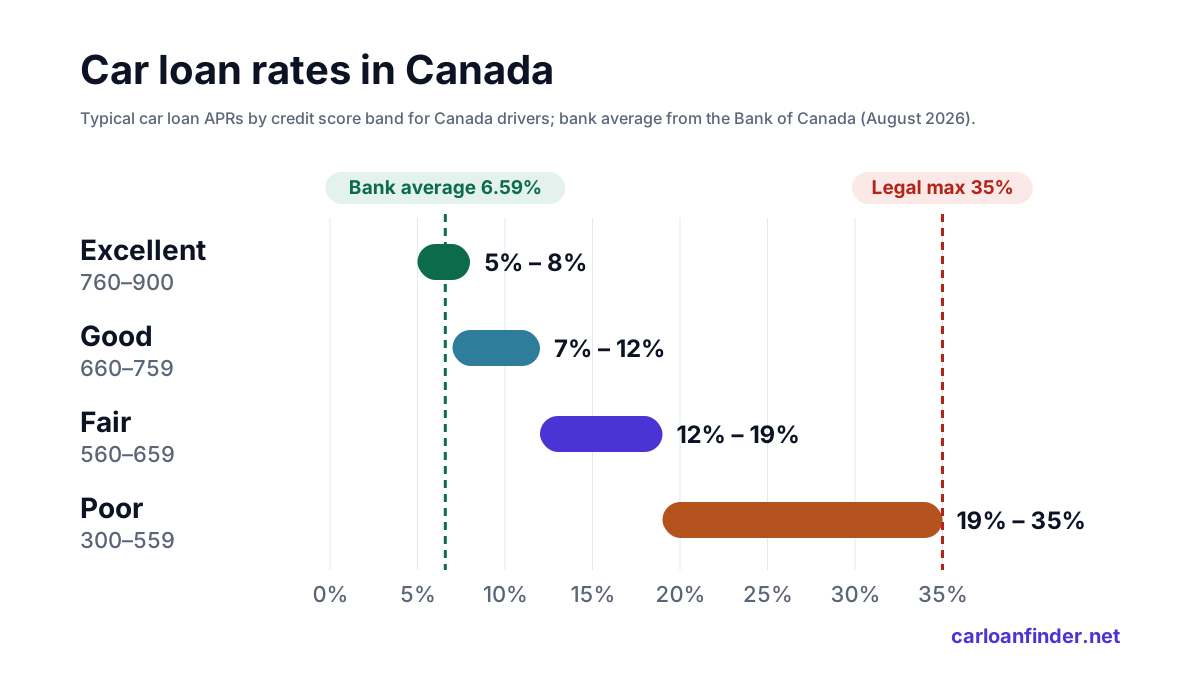
The rate drives how steep that curve is. Chartered banks averaged 6.59% on new auto loans in August 2026, according to the Bank of Canada. Equifax publishes estimates of 12%–19% for fair credit and 19%–35% for poor credit. At those higher rates, interest takes a much bigger bite out of each early payment.
Term length: the trade-off behind a lower payment
Stretching the same loan from 60 to 84 months spreads the principal over more payments, so each one is smaller. But you are also paying interest for two extra years, on a balance that shrinks more slowly. The total cost of borrowing goes up, sometimes by a lot when the rate is high.
A long term also raises the risk of negative equity, meaning you owe more than the car is worth. Cars lose value fastest in their first years, while a long amortization reduces the balance slowly in those same years. If you need to sell or trade in early, you may have to cover the gap or roll it into your next loan.
A practical approach is to work backward from your budget and pick the shortest term whose payment fits comfortably in your budget after insurance, fuel and maintenance. If only an 84-month term makes the numbers work, that can be a sign to look at a less expensive car or a larger down payment instead.
Reading an amortization schedule before you sign
An amortization schedule is a table with one row per payment. It shows the payment amount, how much goes to interest, how much goes to principal, and the balance left afterward. Lenders and dealers can print one from the same numbers in your contract, and you are entitled to understand what you are agreeing to.
Check three things on it. First, the payment frequency: weekly or biweekly payments are amortized differently from monthly ones. Second, the total interest over the term, which is often more revealing than the rate alone. Third, the balance at the point where you might trade the car in, to see how much equity you are likely to have.
Also compare the schedule against the cost of borrowing disclosed in the contract. If the numbers do not match, ask why. Fees, add-on products or extended service contracts financed into the loan increase the amount being amortized, and they should be listed clearly so you can decide whether you want them.
Paying it down faster
Any extra money that goes toward principal reduces the balance that interest is charged on, so every later payment does a little more work. Even small top-ups made early in the term can trim several payments off the end. Ask the lender whether extra payments are applied to principal and whether there is a prepayment charge.
Rounding up your payment, switching to biweekly payments, or putting a tax refund toward the loan are simple ways to do it. Before you prepay, though, make sure you have an emergency fund, and pay off any credit card balances first, since those usually carry a higher rate than a car loan.
If your credit has improved since you signed, refinancing at a lower rate starts a new amortization schedule with less interest built in. Car Loan Finder is not a lender; it checks options with a soft inquiry that does not affect your credit score, so you can see whether a better rate is realistic before applying anywhere.
Amortization works the same way across Canada, but what gets amortized does not. Sales tax depends on the province: some charge a single harmonized HST, others charge GST plus a separate provincial tax, and the Canada Revenue Agency publishes the rates. When tax is rolled into the loan, you pay interest on it for the whole term. Insurance also differs, with public insurers in some provinces, so budget for it separately from the loan payment.
Questions about this topic
What does amortization mean on a car loan?
It means the loan is repaid in equal, regular payments that cover both interest and principal. By the last payment, the balance reaches zero.
Why does so little of my payment go to principal at first?
Interest is charged on the outstanding balance, which is highest at the start of the loan. As the balance drops, the interest portion shrinks and more of each payment reduces what you owe.
Is an 84-month car loan a bad idea?
Not always, but it costs more in total interest than a shorter term at the same rate. It also keeps the balance high while the car loses value, which raises the risk of owing more than the car is worth.
Can I pay off my car loan early in Canada?
Many car loans allow it, but some contracts include a prepayment charge, so read yours or ask the lender. Extra payments applied to principal reduce the total interest you pay.
How do I get an amortization schedule for my auto loan?
Ask the lender or dealer's finance office for one based on your contract. You can also build one in a spreadsheet using the amount financed, the rate, the term and the payment frequency.
Does a higher interest rate change the amortization?
Yes. A higher rate means a larger share of each early payment goes to interest, so the principal falls more slowly. Under the Criminal Code, the annual rate cannot exceed 35% APR since January 1, 2025.