Line every quote up on the same terms
Start by writing each offer on one sheet with four columns: amount financed, term in months, APR and total of all payments. Dealers often present the payment first because it is the easiest number to make attractive. Stretching a loan from 60 to 84 months lowers each payment, yet it adds two more years of interest. Unless both quotes use the same term, a lower payment tells you almost nothing about which loan is cheaper.
Check that the amount financed matches too. One quote may include an extended service contract, rust protection or a tire package that another leaves out, which inflates the balance while the rate looks identical. Ask each lender or dealer for an itemized breakdown, remove the extras you did not ask for, and then recalculate. Only when the amount and term are equal can you compare the rates honestly.
Read the APR, then hunt for fees
The interest rate printed on an advertisement and the annual percentage rate in your contract are not always the same number. The APR is meant to reflect the yearly cost of borrowing including most lender charges, so it is the figure to compare. If a lender quotes only a rate, ask for the APR in writing. A gap between the two usually means administration, registration or lender fees have been built into the loan.
Also look for costs that sit outside the APR: dealer documentation charges, optional insurance products and penalties for paying the loan off early. A loan with a slightly higher rate but no prepayment penalty can cost less overall if you plan to pay it down faster. Write these terms beside each quote so the comparison covers the full cost, not just a percentage.
Use published averages as a yardstick
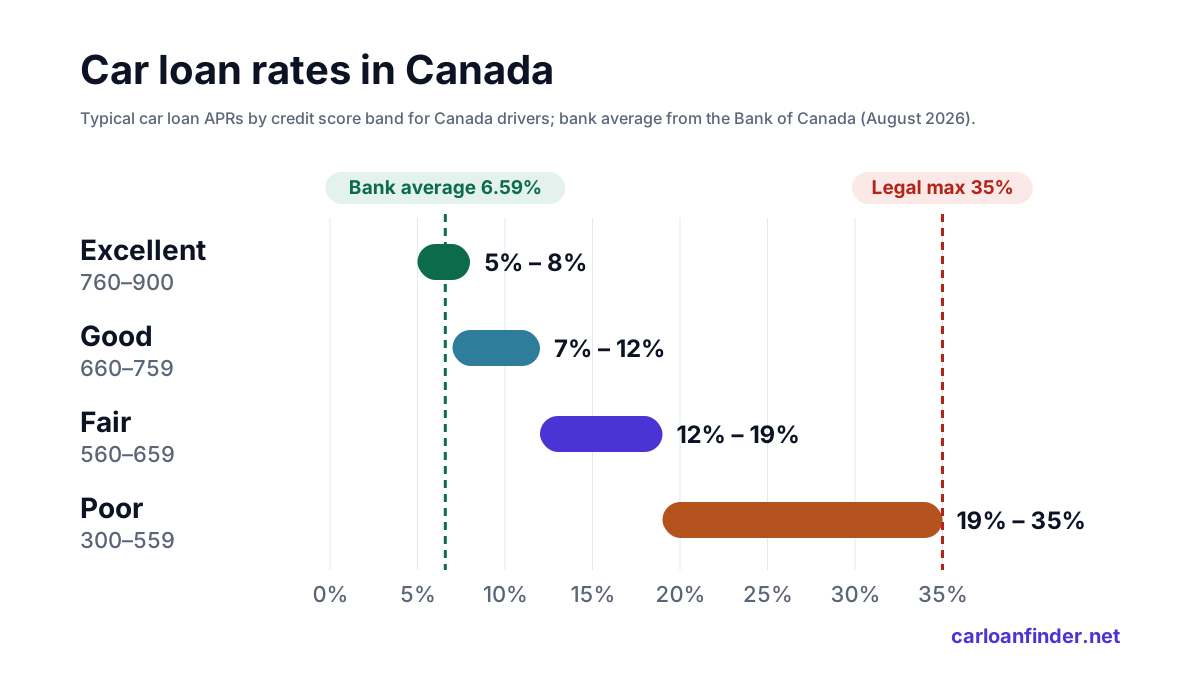
Bank of Canada data gives you a reference point. In August 2026, chartered banks charged an average of 6.59% on new auto loans and 6.83% on existing ones, while the prime rate stood at 4.45% in October 2026. These figures describe bank lending to borrowers who qualify at a bank, so they are a benchmark rather than a promise of what any one person will be offered.
Equifax score bands give a wider view. Published estimates put excellent scores (760–900) at roughly 5%–8%, good scores (660–759) at 7%–12%, fair scores (560–659) at 12%–19% and poor scores (300–559) at 19%–35%. If your quote sits well above the band for your score, ask why. If it sits inside the band, the next question is whether fees and term make it the cheaper loan.
Shop several lenders without wasting your score
Each full application usually triggers a hard inquiry on your credit report, and a string of them spread over months can look like credit seeking. Credit scoring models generally treat several auto loan inquiries made close together as a single shopping event, so do your comparing within a short window rather than one application every few weeks. Gather your documents first so you can move quickly once you start.
Before any hard inquiry, use tools that rely on a soft check. Car Loan Finder is not a lender; it matches you with lenders and dealers using a soft inquiry that does not affect your credit score. That lets you see which kinds of lenders are likely to work with your file before you commit to formal applications and compare written offers side by side.
The rate itself is set by the lender and your credit file, but the amount you borrow depends partly on where you live. Sales tax on a vehicle differs by province: some charge only the federal GST, others a combined HST, and others add a separate provincial tax, so the same car can need a different loan in two provinces. Insurance also varies, since a few provinces run public auto insurers while the rest rely on private companies. In Quebec, winter tires are required from December 1 to March 15, an extra cost worth budgeting before you settle on a loan amount.
Questions about this topic
What is the difference between an interest rate and an APR on a car loan?
The interest rate is the cost of borrowing the principal alone. The APR folds in most lender fees and expresses the total as a yearly percentage, which makes it the better figure for comparing offers.
Is a lower monthly payment always the cheaper car loan?
No. A lower payment often comes from a longer term, and every extra month adds interest. Compare the total of all payments on equal terms to see which loan really costs less.
How many car loan quotes should I compare?
Three or four written offers is usually enough to see a pattern. Try to gather them within a short period so the credit inquiries are treated as one shopping event.
What is a normal car loan rate in Canada right now?
Bank of Canada data shows chartered banks averaged 6.59% on new auto loans in August 2026. Borrowers with fair or poor credit are often quoted more, with published Equifax-band estimates running from 12%–19% for fair scores and 19%–35% for poor ones.
Does comparing car loans hurt my credit score?
Formal applications usually create hard inquiries, which can lower a score slightly. Pre-qualification tools that use a soft inquiry, such as Car Loan Finder, do not affect your credit score.
Can a lender charge more than 35% on a car loan?
No. Since January 1, 2025, the Criminal Code sets the criminal interest rate at 35% APR. If an offer comes close to that limit, read every fee carefully and keep comparing.