What the calculator actually tells you
Every car loan calculator works the same way. You enter the amount financed, the interest rate and the number of months, and it works out the payment that clears the balance by the end of the term. Most also show the total interest you will pay, which is the figure that tells you what the loan really costs. If yours does not, look for one that does.
That makes the calculator a planning tool, not a quote. It has no idea what a lender will charge you, what fees the dealer adds, or whether the car qualifies for financing. Its answer is a mirror of what you type in. Used carefully, it shows you a realistic range; used carelessly, it shows you the payment you hope for.
A good habit is to work backwards. Decide first what you can comfortably pay each month after rent, insurance, fuel and savings. Then use the calculator to find the price that payment supports at a realistic rate and a reasonable term. Shopping with that ceiling in mind is far easier than talking yourself down from a car you have already driven.
Entering realistic numbers
Start with the amount financed, not the sticker price. Add sales tax, dealer fees and any add-ons you plan to buy, then subtract your deposit and the value of a trade-in. If you still owe money on the trade-in, add that balance back, because it will become part of the new loan.
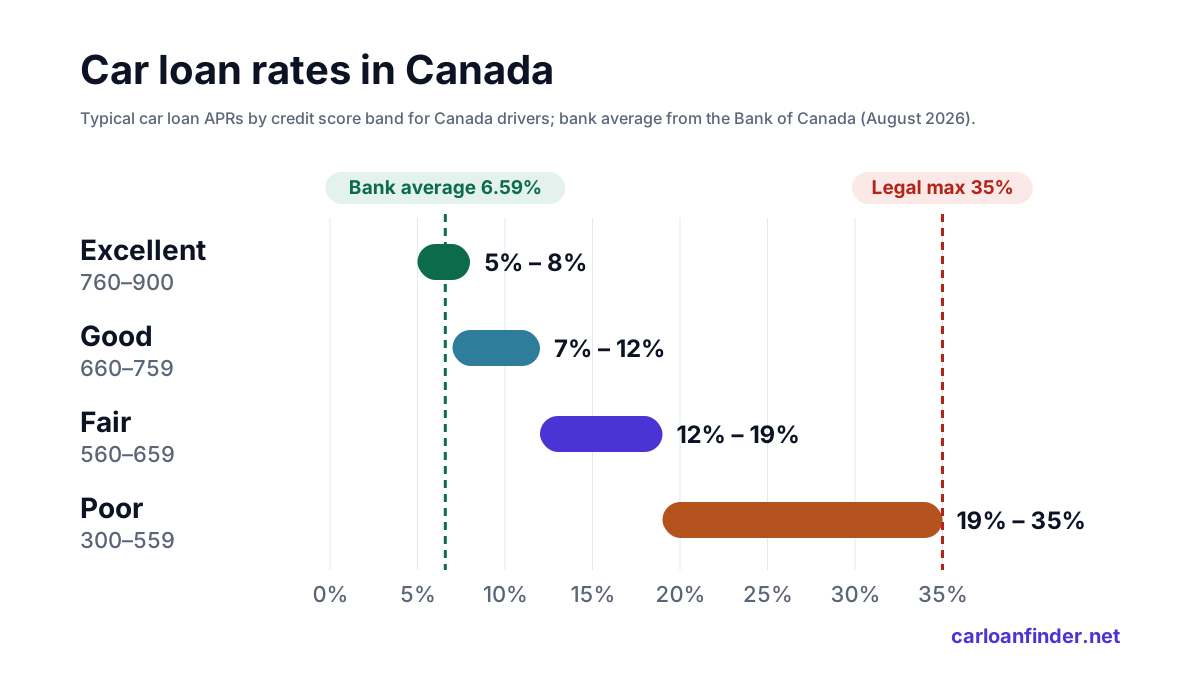
The rate is where most estimates go wrong. Use your credit tier rather than an advertised rate. Published estimates by Equifax score band put excellent credit (760–900) at about 5%–8%, good credit (660–759) at 7%–12%, fair credit (560–659) at 12%–19% and poor credit (300–559) at 19%–35%. If you are unsure of your score, run the calculation at both ends of the likely band.
For a reference point, the Bank of Canada reported an average of 6.59% on new auto loans at chartered banks in August 2026. That average describes lending at chartered banks, not the subprime lenders that work with damaged credit. If your score is fair or poor, entering the bank average will understate your payment, sometimes by a wide margin, and the surprise will come at the dealership instead.
Testing scenarios before you shop
Change one input at a time and watch the total interest, not just the payment. Lengthening the term lowers the payment but adds months of interest; shortening it does the reverse. Seeing both numbers side by side makes it clear how much a long term really costs, and helps you pick the shortest term your budget can hold.
Try the effect of a larger deposit, too. Each dollar you put down reduces the amount financed and the interest charged on it, and the calculator shows exactly how much. Run the same loan at the top and bottom of your credit band to see what improving your score could save, which can make waiting a few months before buying worthwhile.
Some calculators let you switch between monthly and biweekly payments. Paying more often can trim interest slightly, depending on how the lender applies payments, but the bigger savings almost always come from the rate, the term and the deposit. Treat payment frequency as a fine-tuning choice once the main numbers are set.
From estimate to a real offer
A calculator cannot tell you what you will actually be offered, and it leaves out costs a lender never sees: insurance, fuel, maintenance and registration. Add those to your monthly budget separately. If the loan payment plus running costs leaves no room for an unexpected repair, aim for a less expensive car or a larger deposit.
When an offer arrives, check it against your estimate. If the rate is higher than your tier suggests, ask why. Since January 1, 2025, the Criminal Code has capped interest at 35% APR, and any offer near that ceiling deserves a careful second look. Compare offers on the total cost of borrowing, which the lender must disclose.
To replace a guess with a realistic rate, you can check your options before applying anywhere. Car Loan Finder is not a lender; it checks options with a soft inquiry that does not affect your credit score. Plugging a rate based on your own profile into the calculator gives you an estimate worth taking to the dealership.
The biggest number most people leave out of a calculator is sales tax, and it depends on your province. Some provinces charge GST plus a provincial sales tax, others a single HST; the Canada Revenue Agency publishes the rate for each, so add the right one to the price before you calculate. Insurance never appears in a loan calculator, and it differs depending on whether your province has a public insurer or private companies. In Quebec, budget for winter tires as well, since they are required from December 1 to March 15.
Questions about this topic
How accurate are online car loan calculators?
The math is accurate, but the result depends entirely on what you enter. With a realistic rate, the full amount financed and the right term, the estimate will be close. With an advertised rate or a missing tax amount, it will not.
What interest rate should I put in a car loan calculator?
Use the range for your credit tier. Published estimates by Equifax score band run from about 5%–8% for excellent credit to 19%–35% for poor credit. Run the calculation at both ends of your likely range.
Should I include sales tax in the loan amount?
Yes, if you plan to finance it rather than pay it in cash. Add your province's GST, HST or provincial sales tax to the price, along with fees and add-ons, before calculating.
Does a longer term make a car cheaper?
It makes the payment smaller but the total cost larger, because you pay interest for more months. Compare the total interest at different terms in the calculator before deciding.
Does using a car loan calculator affect my credit score?
No. A calculator does not access your credit file at all. Checking your options with Car Loan Finder uses a soft inquiry, which also does not affect your credit score.
Is a calculator result the same as a pre-approval?
No. A calculator only estimates a payment from the numbers you provide. A lender's offer depends on your income, credit history, the vehicle and the term.